


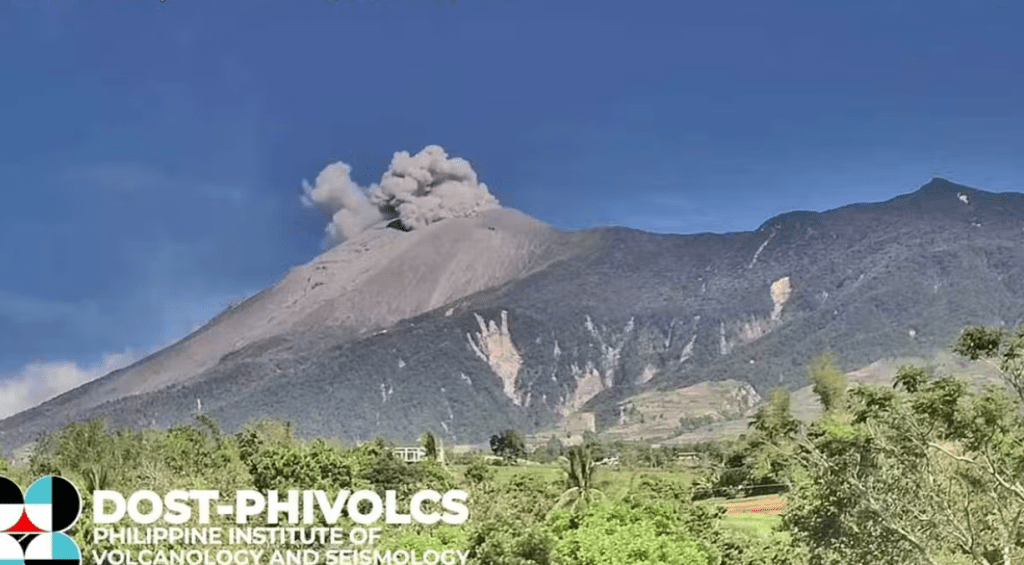
BACOLOD CITY, Philippines — Authorities are racing against time as a massive bushfire continues to gut approximately 150 hectares of grassland on the slopes of Mt. Kanlaon, with the flames currently concentrated within the volcano’s permanent danger zone (PDZ).
The Bureau of Fire Protection (BFP) and the Protected Area Management Board (PAMB) confirmed on Thursday that the fire, which started earlier this week, is spreading rapidly due to strong winds and the prevailing dry spell affecting Western Visayas.
The fire’s location—situated roughly four to five kilometers from the crater—presents a significant challenge for emergency responders. Because the blaze is deep within the 4-kilometer Permanent Danger Zone (PDZ), ground crews are restricted from entering the area due to the heightened risk of volcanic activity and falling rocks.
- Aerial Assault: The Philippine Air Force (PAF) has been tapped to conduct “Bambi Bucket” operations, using helicopters to drop water on the advancing fire lines.
- Containment Lines: Local volunteers and forest rangers are focusing on creating “firebreaks” outside the PDZ to prevent the flames from reaching nearby coffee and vegetable plantations in Canlaon City and La Castellana.
Environment officials noted that the high temperatures and lack of rainfall have turned the mountain’s lush grasslands into a “tinderbox.”
“The grass is extremely dry, and the terrain is very steep,” said a representative from the Department of Environment and Natural Resources (DENR). “Even a small spark, whether from a lightning strike or human activity, can ignite a massive blaze in these conditions.”
The Philippine Institute of Volcanology and Seismology (PHIVOLCS) clarified that while the fire is on the volcano, it is not caused by volcanic activity. Mt. Kanlaon remains under Alert Level 1 (Abnormal), meaning there is slight increase in volcanic earthquakes and steam-driven explosions, but no imminent magmatic eruption.
However, the agency warned that the thick smoke from the fire could mix with volcanic sulfur dioxide ($SO_2$), potentially creating “vog” (volcanic smog) that could pose respiratory risks to residents in downwind communities.
The 150-hectare loss is a significant blow to the Mt. Kanlaon Natural Park, a key biodiversity area. The fire is reportedly encroaching on habitats of endemic species, including the Negros Bleeding-heart pigeon and various rare orchids.
“We are not just fighting to save property; we are fighting to save one of the last remaining primary forests in the region,” a local conservationist shared.
While no residential areas have been reached by the fire yet, the Office of Civil Defense (OCD) has placed nearby barangays on “standby alert.” Residents are advised to prepare “Go Bags” and wear masks if the smoke haze becomes too thick.
Authorities are also investigating the possibility of “kaingin” (slash-and-burn farming) or a discarded cigarette butt as the potential cause of the blaze, though no official conclusion has been reached.