


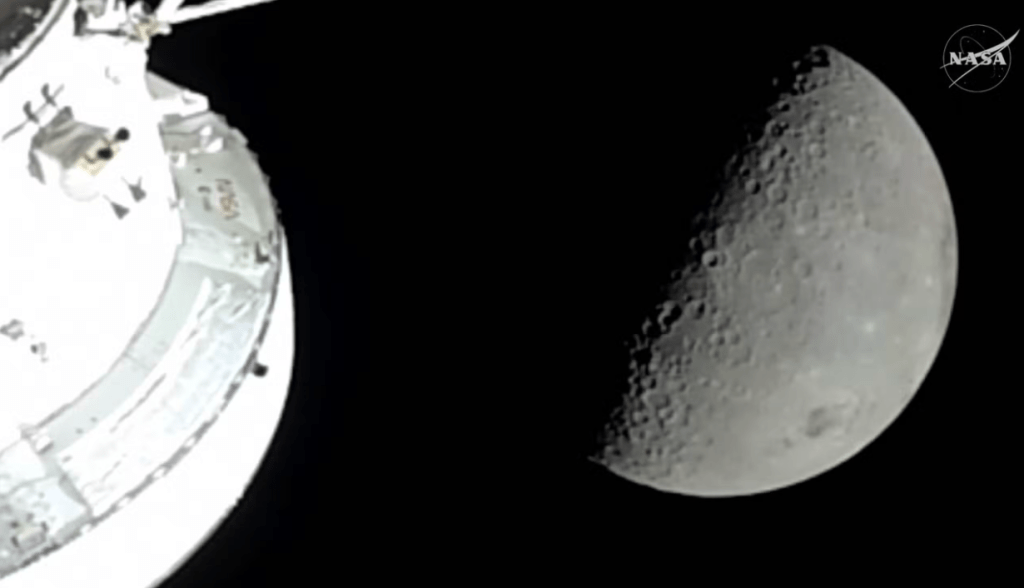
HOUSTON, Texas — Over half a century after the last human footsteps on the lunar surface, humanity has returned to the Moon’s doorstep. On Monday, April 6, 2026, the four astronauts of NASA’s Artemis II mission completed a historic flyby, traveling further from Earth than any human being in history.
The crew—Commander Reid Wiseman, Pilot Victor Glover, and Mission Specialists Christina Koch and Jeremy Hansen—shattered the long-standing distance record set by the Apollo 13 mission in 1970. At the journey’s furthest point, the Orion spacecraft, named Integrity, reached a staggering 252,756 miles (406,771 kilometers) from our home planet.
Unlike the low-altitude orbits of the Apollo era, Artemis II followed a “free return” trajectory that took the crew approximately 4,067 miles (6,545 kilometers) above the lunar surface. This unique vantage point allowed the astronauts to see the Moon as a complete sphere—appearing to them “about the size of a basketball held at arm’s length.”
During a meticulously planned seven-hour observation window, the crew documented 30 specific lunar targets. They provided live descriptions of the “terminator”—the moving line between the Moon’s day and night—detailing the rugged, cratered landscape with a human perspective that robot-taken photos often lack.
“I just had an overwhelming sense of being moved by looking at the moon,” Christina Koch radioed back to Mission Control in Houston. “It reminds us how much we have in common. Everything we need, Earth provides.”
The mission included a dramatic 40-minute communications blackout as the spacecraft passed behind the far side of the Moon. During this period, the crew witnessed a breathtaking “Earthset,” followed by an “Earthrise” as they emerged back into view of their home planet.
“It is so great to hear from Earth again,” Koch remarked as signal was restored. “We will always choose Earth; we will always choose each other.”
Adding to the mission’s scientific value, the astronauts witnessed a rare celestial event shortly after their closest lunar approach: a total solar eclipse from deep space. For approximately one hour, the Moon perfectly aligned with the Sun from the spacecraft’s perspective.
The crew used this unique geometry—where the Moon appeared five times larger than the Sun—to study the solar corona, the Sun’s wispy outer atmosphere. They also monitored the lunar nightside for “impact flashes,” successfully spotting four flickers of light caused by meteoroids striking the surface.
With the lunar flyby complete, Integrity has begun its four-day trek back to Earth. The mission is scheduled to conclude with a splashdown in the Pacific Ocean on April 10, 2026. This successful flight paves the way for Artemis III, which aims to land the first woman and the first person of color on the lunar South Pole in the coming years.