
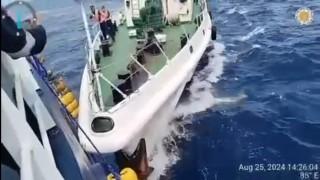

The Australian government has called on China to stop its “dangerous and aggressive” behavior in the West Philippine Sea (WPS) following a recent incident at Escoda Shoal, where a Chinese Coast Guard (CCG) vessel allegedly “intentionally” rammed the Philippine patrol ship BRP Teresa Magbanua.
Australian Ambassador to the Philippines, HK Yu, shared on X (formerly Twitter) the Australian government’s statement expressing deep concern over China’s actions, highlighting a series of incidents on August 19, 25, and 31 near Sabina Shoal, also known as Escoda Shoal.
The statement condemned the “repeated and intentional ramming of Philippine vessels, causing structural damage, and the use of water cannons,” which Australia views as “destabilizing and unacceptable conduct.” The Australian government stressed that these actions pose serious risks to the safety of the crew and undermine efforts to de-escalate tensions in the South China Sea.
“The Australian Government urges China to cease these actions, resolve disputes peacefully, and adhere to international law, particularly the United Nations Convention on the Law of the Sea (UNCLOS) and conventions on the prevention of collisions at sea,” the statement said.
Australia also called for restraint and reaffirmed that the 2016 South China Sea Arbitral Award is “final and legally binding on the parties.”
The incident over the weekend involved a CCG vessel that “intentionally” and repeatedly rammed the BRP Teresa Magbanua, which has been anchored at Escoda Shoal since April. In contrast, Liu Dejun, a spokesperson for China’s Coast Guard, claimed that a Philippine ship “illegally stranded” at the shoal had lifted its anchor and “deliberately rammed” a Chinese vessel.
In response to the incident, Philippine Foreign Affairs Secretary Eduardo Manalo mentioned that the Philippine government is considering filing another arbitral case against China.
Escoda Shoal, also known as Sabina Shoal, is a coral reef formation with a central lagoon, surrounded by discontinuous shallow areas. It serves as a rendezvous point for Philippine vessels heading to Ayungin Shoal (Second Thomas Shoal), where the World War II-era vessel BRP Sierra Madre has been aground since 1999. Both features are contested in the West Philippine Sea.