
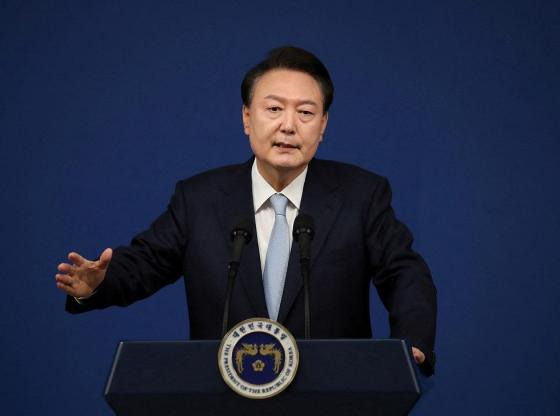

South Korean President Yoon Suk Yeol is facing intense calls for resignation or impeachment after declaring martial law on Tuesday, only to rescind it hours later following a standoff with parliament. The crisis has sparked protests and rattled the nation’s political stability.
Late Tuesday, Yoon announced martial law, citing threats from nuclear-armed North Korea and anti-state forces. However, the declaration quickly faced backlash, with parliament rejecting measures to restrict political activity and censor media. Armed troops entered the National Assembly building, leading to chaotic scenes.
Political and Public Outrage
The main opposition Democratic Party (DP) accused Yoon of being unfit to govern. “It was clearly revealed to the entire nation that President Yoon could no longer run the country normally. He should step down,” said senior DP lawmaker Park Chan-dae.
Six opposition parties, including the DP, plan to submit an impeachment bill, with voting expected by Friday or Saturday.
Swift Reversal of Martial Law
Within hours of the declaration, parliament, including members of Yoon’s ruling People Power Party (PPP), unanimously passed a motion to lift martial law. Protests erupted outside the National Assembly, with demonstrators celebrating the reversal.
Yoon defended his actions, claiming martial law was constitutional and necessary to protect South Korea’s free order. However, critics pointed to procedural flaws and a lack of clear justification for such extreme measures.
Economic and Diplomatic Fallout
The crisis has shaken South Korea’s financial markets, with stocks falling 2% and the won stabilizing after hitting a two-year low, prompting government intervention to calm markets. Emergency measures were announced to inject liquidity if needed.
Internationally, the turmoil led to the postponement of defense talks and joint military exercises with the United States, which maintains 28,500 troops in South Korea. Sweden and Japan also postponed diplomatic visits to Seoul.
Impeachment and Potential Leadership Transition
Impeaching the president requires a two-thirds vote in the 300-member National Assembly and confirmation by the Constitutional Court. If Yoon is removed, Prime Minister Han Duck-soo would temporarily assume leadership until a new election is held within 60 days.
President Yoon, a former prosecutor, narrowly won the presidency in 2022 but has struggled with low approval ratings, hovering around 20%. His People Power Party suffered a major defeat in April’s parliamentary elections, losing control of the legislature to opposition parties.
Historical Context
Martial law has been declared over a dozen times in South Korea’s history, most notably in 1980, when military officers used it to suppress pro-democracy movements. Critics have likened Yoon’s actions to that era, further fueling public discontent.
The U.S. welcomed Yoon’s reversal of martial law. Secretary of State Antony Blinken stated, “We continue to expect political disagreements to be resolved peacefully and in accordance with the rule of law.”