


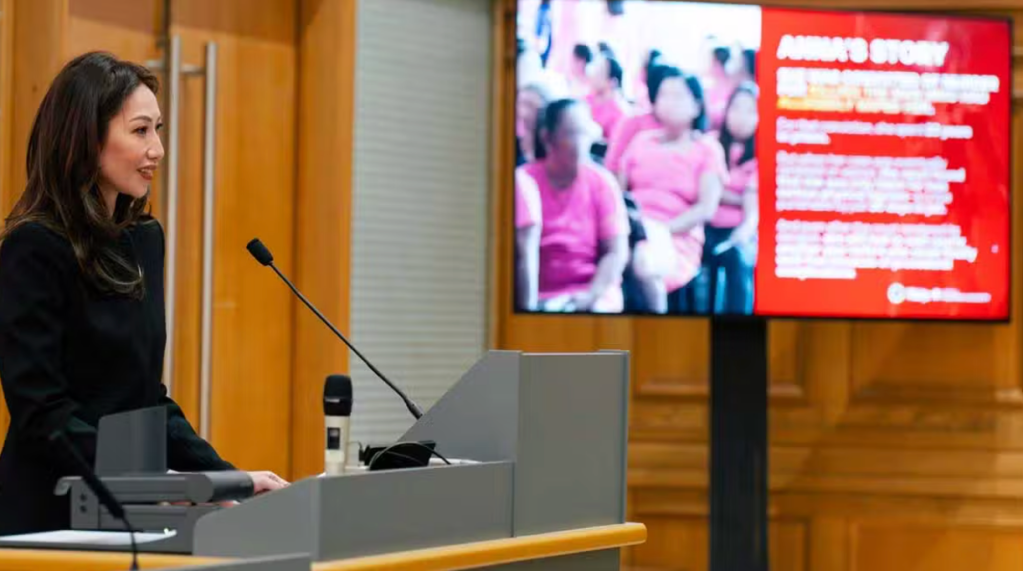
LONDON, United Kingdom — Justice is often envisioned as a judge’s gavel or a dusty law book, but according to Philippine Department of Justice (DOJ) Undersecretary Margarita Gutierrez, true justice is found in the accessibility of the system to the common citizen.
Speaking at the Philippine Democracy Series 2026 at the London School of Economics and Political Science (LSE), Gutierrez challenged traditional legal frameworks, urging global leaders to look “beyond the courts” to ensure that the rule of law serves the most vulnerable members of society.

During her address, Gutierrez underscored a sobering reality: legal protections are hollow if the people who need them most—particularly women and children—remain barred from accessing them due to poverty, geography, or lack of information.
“Justice is not defined by the laws we pass,” Gutierrez told the forum, “but by whether those laws truly serve the people who depend on them.”
To illustrate the human cost of systemic failure, she shared the harrowing story of a woman who spent over two decades in a Philippine prison for a conviction that was eventually overturned. The high court later ruled her liability was limited to a minor offense carrying a maximum sentence of only 30 days.
“Imagine, it was only 30 days, but she served 23 years,” Gutierrez said, pointing to the procedural barriers and lack of early legal assistance that stole decades from a woman’s life.

The Undersecretary highlighted that the Philippines is actively working to dismantle these barriers through grassroots outreach. She pointed to flagship programs like the DOJ Action Center and the Katarungan (Justice) Caravan, which bring legal services directly into rural and underserved communities.
“If people cannot come to justice, then justice must go to them,” Gutierrez said, framing accessibility as both a policy priority and a moral obligation. According to the DOJ, these initiatives have already provided legal aid and referrals to more than 50,000 Filipinos since 2023.

Addressing an audience of students, academics, and the Filipino community, Gutierrez called for a shift in how leadership is defined in the legal sector. She argued that true success shouldn’t be measured by visibility, but by the strength of the institutions left behind.

“When women lead, institutions begin to ask better questions—who is being left behind, who cannot access services, who still has no voice,” she noted. “The true measure of leadership is not the position we hold, but the system that we leave behind.”
As the forum concluded, Gutierrez’s message remained clear: for justice to be real, it must be felt on the ground, long before—and far beyond—the strike of a judge’s gavel.