


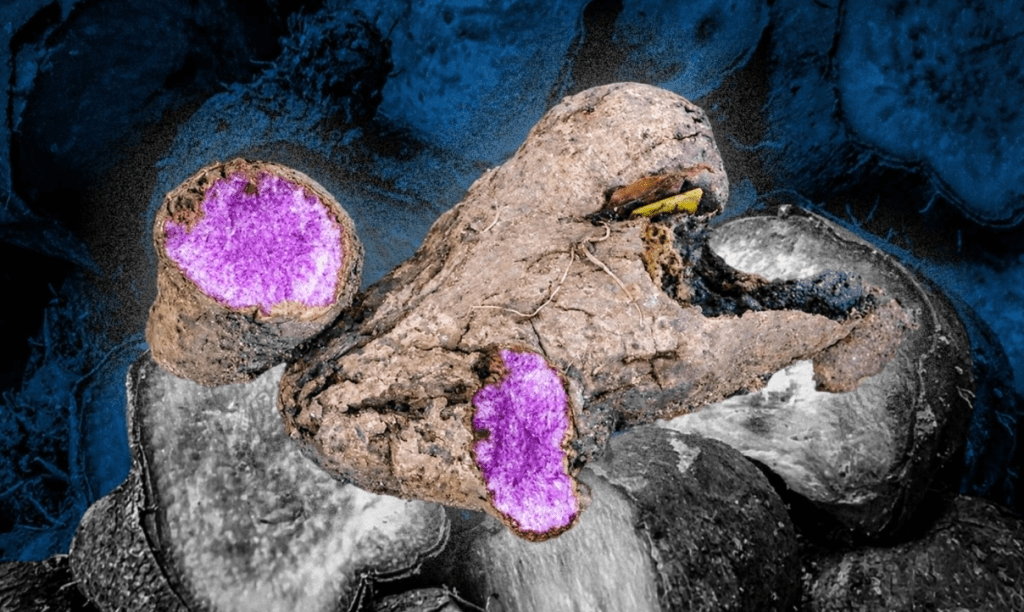
MANILA, Philippines — In a breakthrough for the Philippine purple yam industry, a new study published on Tuesday, May 12, 2026, by agricultural expert Teodoro C. Mendoza, outlines a scalable pathway to overcome the “tuber barrier” that has long stifled ube (Dioscorea alata) production.
The paper argues that moving away from traditional tuber-based planting toward farmer-led clonal propagation could revolutionize the industry, allowing the Philippines to meet surging global demand while empowering local cooperatives.
Ube production in the Philippines has faced a paradox: while global exports are booming, domestic supply has declined from 15,000 metric tons in 2021 to just 12,483 metric tons in 2025.
- Inefficient Propagation: Traditionally, farmers use pieces of the harvested tuber for replanting. This is costly, as the “seeds” (tubers) are also the food product being sold.
- Low Multiplication: One kilogram of tuber typically produces only a few viable plantlets under traditional methods.
- Disease Risk: Tubers often carry soil-borne pathogens, leading to low survival rates in new crops.
- High Costs: Tissue culture, while effective, remains too technically demanding and expensive for the average Filipino farmer.
The study highlights three low-cost, farmer-accessible techniques that can significantly boost planting stock without relying on expensive laboratory equipment.
1. Sprout Division
By allowing tubers to sprout for two weeks before cutting and replanting the rooted sprouts, farmers can maximize efficiency.
- Efficiency: A 1-kg tuber can produce 50 to 60 plantlets, compared to only 15 using traditional methods.
- Sustainability: Tubers can be reused for multiple rounds of sprout harvesting until exhausted.
2. Stem Cuttings
Once ube vines reach about 3 feet in length, stems can be cut into single- or double-node sections.
- Survival Rate: With proper nursery management, these cuttings have a 70% to 85% survival rate.
- Scalability: This allows for the mass production of planting material without sacrificing any part of the edible harvest.
3. Layering Technique
A simple method where vine branches are bent to touch the soil and covered with fertile earth.
- Ease of Use: Roots form naturally at the nodes, creating new plantlets at virtually zero cost to the farmer.
Mendoza argues that these techniques are most effective when managed through federated ube cooperatives.
| Benefit | How it Works |
| Cooperative Nurseries | Shared facilities for mass-producing cuttings and sprouts. |
| Knowledge Transfer | Systematic training for members on clonal techniques. |
| Market Power | Allows smallholders to bypass middlemen and sell directly to processors. |
| Risk Mitigation | Collective pooling of resources to handle climate-related crop losses. |
With ube exports reaching a record $3.06 million in 2025, the Philippines is currently importing ube from Vietnam to satisfy its own local dessert industry. The “Kalinga” for the ube industry involves:
- Policy Support: Pushing for the proposed Philippine Ube Industry Council bill (filed April 2026).
- Training Modules: Developing nationwide DSWD and DA programs to teach these clonal methods.
- Research Integration: Combining these farmer-led methods with selective tissue culture to develop high-yield “elite lines.”
“Clonal propagation is the critical step toward breaking the tuber barrier. It realizes the full potential of ube as a driver of rural development and agricultural resilience in the Philippines.” — Teodoro C. Mendoza