
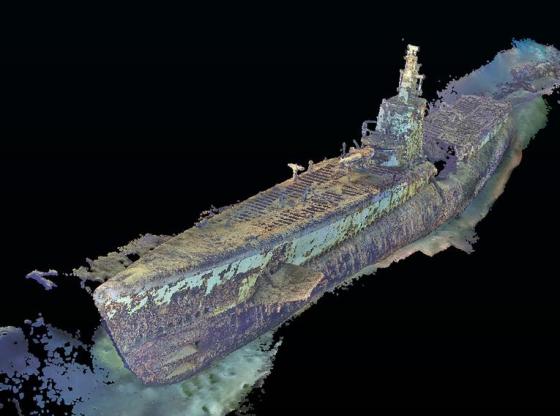

The wreckage of the USS Harder (SS-257), one of World War II’s most renowned submarines, has been discovered off the coast of Pangasinan, Philippines. The find was announced last week by The Lost 52 Project, an organization dedicated to locating and memorializing the 52 U.S. submarines lost during the war.
The USS Harder, credited with sinking the most enemy warships during WWII, was discovered at a depth of over 3,000 feet. The Naval History and Heritage Command confirmed the wreck’s site using data provided by Tim Taylor, CEO of Tiburon Subsea and The Lost 52 Project. According to a news release, the vessel is relatively intact, with only depth-charge damage aft of the conning tower.
Nicknamed “Hit ‘em HARDER,” the Gato-class submarine gained fame for its aggressive tactics against the Imperial Japanese Navy. The Harder completed six successful patrols in just over a year, achieving significant success on its fifth patrol by sinking three Japanese destroyers and heavily damaging two others near Tawi-Tawi in just four days.
The sub’s relentless attacks prompted the Japanese Mobile Fleet to depart Tawi-Tawi a day ahead of schedule, disrupting their plans and contributing to their defeat in the Battle of the Philippine Sea. The Harder’s final mission ended in Dasol Bay, Pangasinan, in August 1944, where it was believed to have been sunk by a depth charge attack from the Japanese escort ship CD-22. The US Navy declared the Harder lost in January 1945, with all 79 crew members on board.
For its outstanding performance, the USS Harder was awarded the Presidential Unit Citation and six battle stars. Its captain, Samuel Dealey, received the Navy Cross four times and was posthumously awarded the Medal of Honor.
The discovery of the USS Harder adds to the historical understanding of WWII naval operations in the Pacific. It is one of approximately 11 US Navy submarines believed to have been sunk in Philippine waters during the war. The find not only honors the bravery and sacrifices of the Harder’s crew but also contributes to the ongoing efforts to preserve and commemorate naval history.