


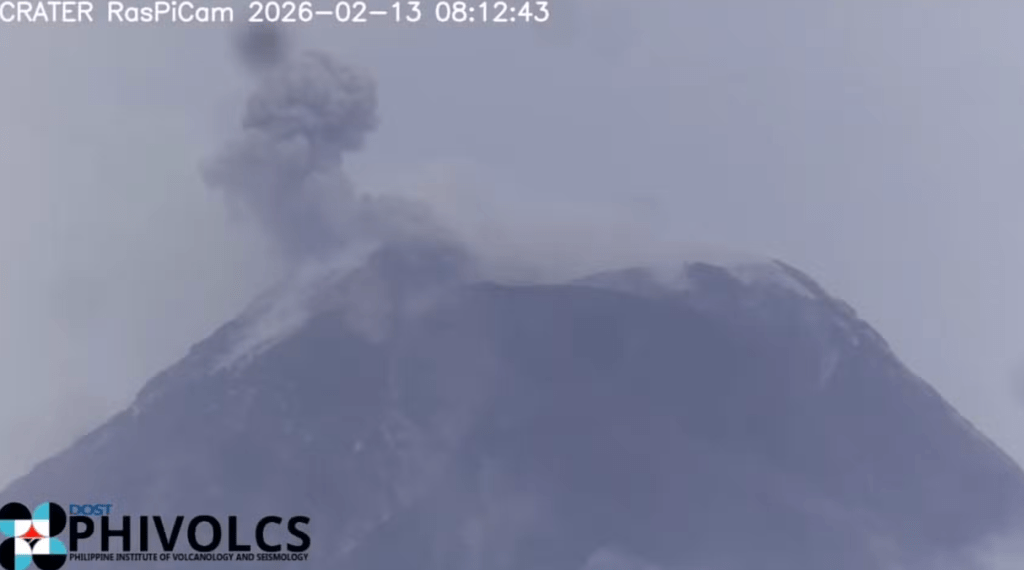
LEGAZPI CITY, Albay — Mayon Volcano has exhibited a slight increase in volcanic activity over the last 24 hours, according to the latest bulletin from the Philippine Institute of Volcanology and Seismology (PHIVOLCS) released on Saturday, February 14, 2026.
Despite the uptick in seismic and surface activity, state volcanologists maintain that the volcano remains under Alert Level 1 (Low-level unrest), though they continue to monitor for signs of a possible escalation.
24-Hour Activity Summary The monitoring network at Mayon recorded the following activity from 5:00 a.m. yesterday to 5:00 a.m. today:
- Volcanic Earthquakes: 12 volcanic earthquakes were recorded, compared to only three during the previous 24-hour window. These tremors are often associated with the movement of magma or hydrothermal fluids beneath the structure.
- Rockfall Events: 18 rockfall events were detected, primarily caused by the instability of the lava dome and the cooling lava flow at the summit.
- Sulfur Dioxide (SO2) Emission: Gas emissions averaged 482 tonnes per day, which is considered within the normal range for Mayon’s current state but slightly higher than the previous week’s average.
- Plume Activity: Moderate steaming produced white plumes reaching 300 meters high, drifting in a West-Southwest and West-Northwest direction.
Ground Deformation Data from continuous GPS and electronic tilt monitoring show that the Mayon edifice remains inflated, particularly on the middle to upper slopes. This long-term inflation indicates that magma is still residing at shallow levels beneath the crater.
Public Safety Reminders PHIVOLCS has reiterated its warnings to the public to ensure safety around the Bicol region’s most active volcano:
- Permanent Danger Zone (PDZ): Entry into the 6-kilometer radius PDZ remains strictly prohibited. This is to avoid risks from sudden phreatic explosions, rockfalls, and landslides.
- Aviation Safety: Pilots are advised to avoid flying close to the volcano’s summit, as ash from any sudden eruption can be hazardous to aircraft engines.
- Lahar Risk: Residents near river channels are urged to remain vigilant against potential lahar or sediment-laden streamflows, especially during heavy rainfall associated with the current weather systems affecting the region.
While the current activity is not indicative of an imminent major eruption, PHIVOLCS continues its 24/7 monitoring. Local government units (LGUs) in Albay have been advised to keep disaster response plans updated as the volcano remains in a state of low-level unrest.