


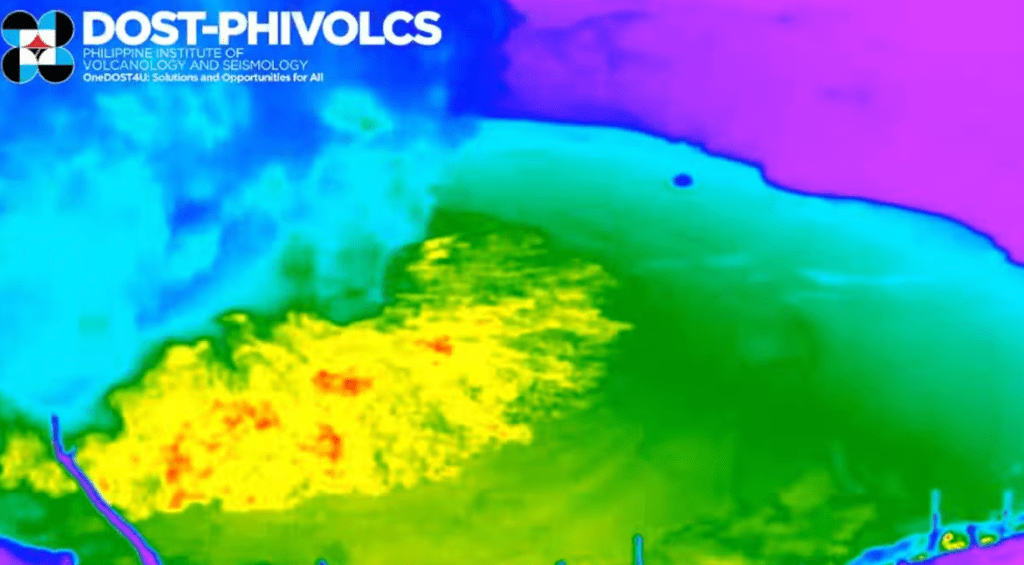
BATANGAS, Philippines — A short-lived, steam-driven explosion rattled Taal Volcano shortly after midnight. The Philippine Institute of Volcanology and Seismology (PHIVOLCS) captured the minor phreatic eruption via its specialized monitoring cameras, reminding nearby lakeside communities of the volcano’s persistent baseline activity.
The thermal cameras stationed at the Main Crater (VTMC) and Daang Kastila (VTDK) logged the thermal signature of the brief event beginning precisely at 12:16 a.m.
The early-morning explosion triggered a visible shift in the volcano’s immediate atmospheric emissions, though the overall thermal energy released remained limited:
- The Plume Height: The steam-driven blast generated gas and ash-tinged plumes that rose up to 300 meters above the rim of the main crater before slowly drifting away.
- 24-Hour Emissions Profile: In the daily monitoring window leading up to the explosion, PHIVOLCS recorded a sulfur dioxide ($\text{SO}_2$) gas flux averaging 1,641 tonnes per day.
- Broader Steaming: Prior to the midnight pop, standard degassing produced much larger, moderate plumes rising as high as 1,500 meters, which drifted toward the west, northeast, and northwest directions.
While a phreatic eruption can look alarming on camera, state volcanologists clarified that the mechanics of the explosion are shallow and do not automatically signal that fresh, explosive magma is rising to the surface.
- The Cause: According to PHIVOLCS and global geological frameworks, a phreatic eruption is purely a steam-driven event. It occurs when hydrothermal water or groundwater trapped beneath the crater floor gets superheated by existing subsurface volcanic gas. The water instantly flashes into steam, expanding violently and tearing through preexisting solid rock.
- Seismic Record: The volcano’s underground plumbing system remains relatively calm. The Taal Volcano Network (TVN) recorded only five volcanic earthquakes over the 24-hour observation cycle, indicating a lack of deep, continuous structural fracturing.
Despite the sudden steam blast, Alert Level 1 (Low-level unrest) remains strictly in place over Taal Volcano. Volcanologists maintain that the current data layout does not warrant raising the alert status to a moderate or critical level.
Nevertheless, authorities are emphasizing that low-level unrest can still produce highly localized, lethal conditions without any immediate warning. PHIVOLCS has forcefully reiterated its safety guidelines to provincial disaster risk councils:
“The public is strictly reminded that entry into the Taal Volcano Island—which is classified as a Permanent Danger Zone (PDZ)—especially near the Main Crater and the Daang Kastila fissures, must remain absolutely prohibited.” — PHIVOLCS Safety Directive
Furthermore, local government units have been advised to maintain strict regulations banning unauthorized civilian boating or tourism across the waters of Taal Lake, while civil aviation authorities continue to warn aircraft against flying close to the volcano’s active summit due to the sudden hazard of airborne ash and toxic gas accumulation.