
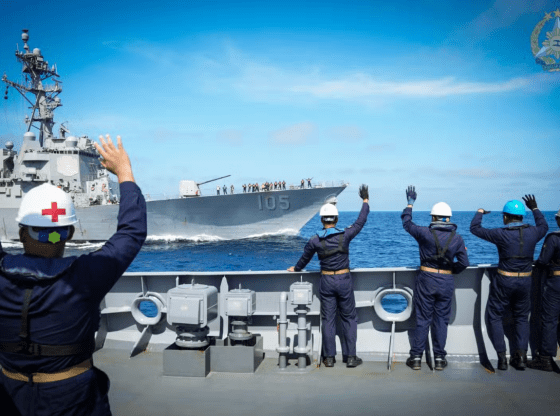


In a bold display of trilateral unity, the Philippines, the United States, and Japan have concluded a week-long series of high-stakes maritime exercises in the Luzon Strait. The 15th Multilateral Maritime Cooperative Activity (MMCA), which ran from February 20 to 26, 2026, marked a historic expansion of these drills toward the northernmost tip of the country.
The exercises focused on “interoperability” and “maritime domain awareness,” signaling a deepening defense alliance as regional tensions remain high.
Historic Reach: Batanes and the Bashi Channel
For the first time, these trilateral drills moved beyond the South China Sea and reached the strategic waters off Batanes.
- Air Patrols: Joint flights involving Philippine FA-50s, a U.S. P-8A Poseidon, and a Japanese P-3C Orion reached as far as the Bashi Channel—a critical chokepoint between the Philippines and Taiwan.
- Naval Maneuvers: The Philippine Navy’s BRP Antonio Luna and the U.S. Navy destroyer USS Dewey sailed as far as Basco, Batanes, conducting tactical maneuvers and anti-submarine warfare drills.
- Strategic Significance: Officials noted that the Bashi Channel is a vital route for international commerce and a key area for regional security, particularly concerning potential Taiwan contingencies.
“Whole-of-Nation” Defense
The drills weren’t just a military affair. The Philippine Coast Guard (PCG) also joined the fray with the BRP Gabriela Silang, highlighting a “whole-of-nation” approach to protecting Philippine sovereign rights.
The week-long activity included:
- Live-Fire Gunnery: The BRP Antonio Luna tested its automated weapon systems under realistic combat conditions.
- Maritime Domain Awareness: Real-time sharing of data to track and monitor vessels in the area.
- Sub-Surface Defense: Anti-submarine exercises aimed at detecting and deterring undersea threats.
Monitoring the “Illegal Presence”
The Philippine military confirmed that the exercises were closely watched by Chinese Navy ships, which were spotted in the vicinity on separate days. While the Chinese vessels did not interfere, Filipino commanders described their presence within the Philippine Exclusive Economic Zone (EEZ) as “illegal and not normal.”
Despite the “shadowing,” the drills proceeded as planned. “It should not be viewed with concern, nor should it be seen by our neighbors as a provocative act,” stated Capt. Jennifer Monforte, emphasizing that the activities were conducted entirely within Philippine territory.
The Philippines, U.S., and Japan concluded the 15th Multilateral Maritime Cooperative Activity (MMCA) in the Luzon Strait on February 26, 2026. The week-long exercise expanded into the waters of Batanes and the Bashi Channel for the first time. Participating assets included the BRP Antonio Luna, USS Dewey, and patrol aircraft from all three nations. The drills focused on anti-submarine warfare, air patrols, and live-fire exercises. While Chinese warships were monitored nearby, the AFP stated the drills were a non-provocative effort to ensure a free and open Indo-Pacific.