
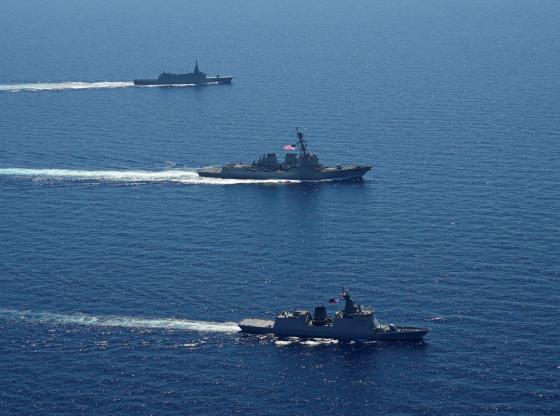

The Armed Forces of the Philippines (AFP) has hailed its recent joint maritime exercises with the United States and Japan as a key step in enhancing regional defense capabilities and responding more effectively to maritime threats in the Indo-Pacific.
The coordinated drills, held on March 28 as part of the Multilateral Maritime Cooperative Activity (MMCA), took place in the West Philippine Sea. AFP Chief of Staff Gen. Romeo Brawner Jr. emphasized that the joint sail enhances interoperability and strengthens the collective ability of allied forces to protect shared interests in the region.
“Each iteration of the MMCA sharpens our coordination, tactical skills, and shared maritime awareness,” Brawner said in a statement.
During the exercise, the Philippines deployed assets including the BRP Jose Rizal (FF-150), AW 109 helicopter, C90 aircraft, and PAF Search and Rescue units. The U.S. Navy contributed the guided missile destroyer USS Shoup (DDG-86), a MH60-R helicopter, and a P-8A Poseidon patrol aircraft. Japan’s Maritime Self-Defense Force participated with the JS Noshiro (FFM-3) and a SH-60K maritime helicopter, following the ship’s inaugural port call at Naval Operating Base Subic.
The drill included communication exercises, helicopter operations, maritime domain awareness and contact reporting, tactical maneuvering, personnel exchanges, and photo operations.
U.S. Defense Secretary Pete Hegseth, visiting Manila during the event, praised the trilateral cooperation and reaffirmed President Donald Trump’s support for stronger alliances in Asia. “Bringing allies together is far more effective than going it alone,” he said during a press briefing.
The activity comes amid heightened tensions in the South China Sea, a critical trade route claimed almost entirely by China — overlapping with the territorial waters of several Southeast Asian nations, including the Philippines. The government refers to its portion of the sea as the West Philippine Sea to assert national sovereignty.
In 2016, the Philippines won a landmark case at the Permanent Court of Arbitration, which ruled China’s sweeping claims had no legal basis. China continues to reject the ruling.