


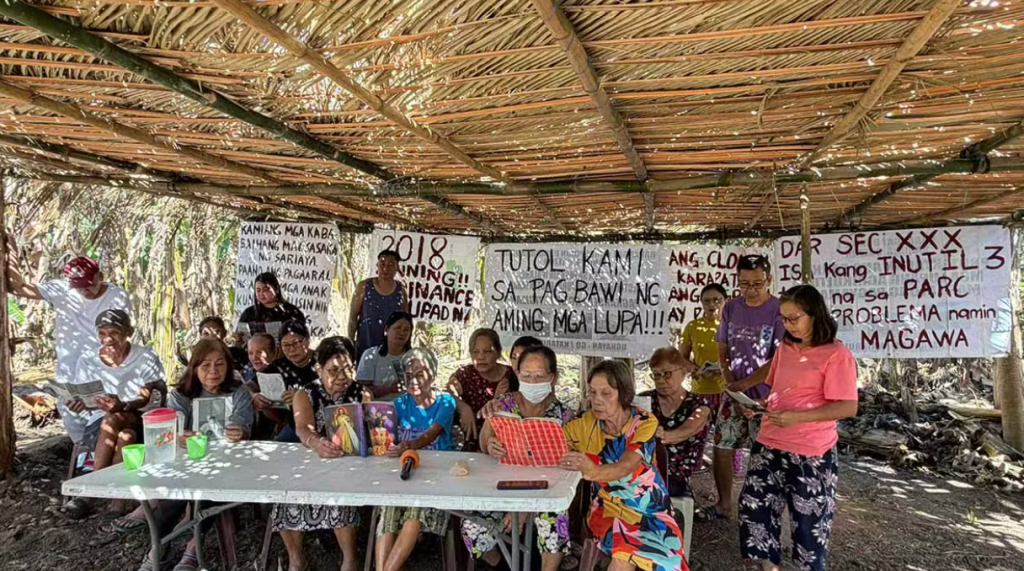
In the heart of Quezon province, the traditional Lenten chanting of the Pasyon has taken on a powerful social dimension as local farmers integrate their decades-long struggle for land reform into their Holy Week observances.
For the agricultural communities of Quezon, the “Pasyon ng Bayan” (Passion of the People) is more than a religious rite; it is a creative and spiritual platform to voice grievances over land displacement, unpaid coconut levies, and the slow pace of agrarian justice. By weaving their contemporary hardships into the narrative of Christ’s suffering, these farmers are transforming a centuries-old tradition into a modern cry for dignity and systemic change.
The Pasyon—a verse narrative of the life, passion, and resurrection of Jesus—is traditionally chanted in 24-hour marathons during Holy Week. However, in several Quezon municipalities, the verses have been adapted to include “stanzas of struggle.”
Farmers recount their experiences of facing “calvaries” in the form of legal battles against large estates and the “crosses” of rising production costs and low copra prices. “We find ourselves in the story of Christ because he, too, was a victim of injustice,” a community leader from a local farmers’ federation shared. The chanting serves as a communal catharsis and a renewed vow to remain steadfast in their claims.
Quezon province has long been a flashpoint for agrarian disputes, particularly involving vast coconut plantations. Despite the passage of various land reform laws over the decades, many tillers remain landless or are caught in protracted litigation with powerful landowning families.
The Pasyon sessions this year specifically highlighted the “unfinished business” of the Coconut Levy Fund—a multi-billion peso fund intended for the benefit of small-scale farmers that has been mired in bureaucratic delays and legal hurdles for years. For the elders in the group, the chanting is a way to pass the history of the movement down to the younger generation, ensuring that the quest for land ownership does not die with the pioneers.
Local clergy in Quezon have largely supported these “politicized” religious expressions, viewing them as a legitimate form of “Social Catholicism.” Parish priests have opened church grounds for these farmers’ gatherings, emphasizing that the Gospel is inseparable from the quest for social justice.
“To pray is to hope for a better world,” a diocesan priest noted. By providing a space for the Pasyon, the Church helps validate the farmers’ plight, framing their struggle not just as a legal issue, but as a moral imperative for the nation.
Despite the somber tone of the Good Friday observances, there is an underlying sense of hope among the participants. The gathering of different farming cooperatives allows for the sharing of resources and strategies, strengthening the provincial network of activists.
The Pasyon also serves as a reminder of resilience. Just as the story of the Passion ends in the Resurrection, the farmers believe that their “Good Friday” of struggle will eventually lead to an “Easter” of genuine land ownership and economic freedom.
As the voices of the Quezon farmers echo through the coconut groves this Holy Week, they hope their message reaches the halls of power in Manila. They are calling on the Department of Agrarian Reform (DAR) and the national government to expedite the distribution of land titles and to ensure that support services reach the most remote agricultural areas.
In the quiet of the Lenten break, the wooden clatter of the matraca and the rhythmic chanting in Quezon serve as a stark reminder that for the Filipino farmer, the walk to Calvary is a daily reality that requires more than just prayers—it requires justice.