
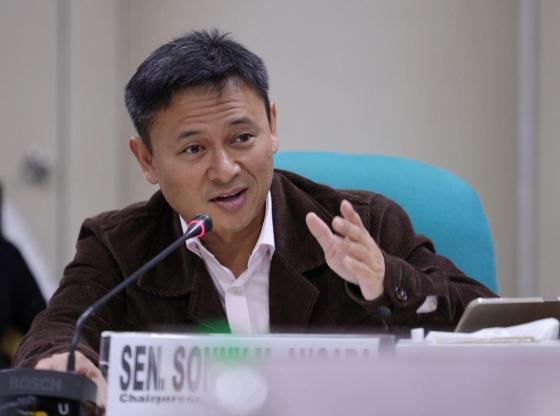

Senator Sonny Angara, the incoming Education Secretary, has expressed his commitment to studying the proposal to increase the entry-level salary of public school teachers to P50,000. President Ferdinand “Bongbong” Marcos Jr. appointed Angara as the successor of Vice President Sara Duterte at the Department of Education (DepEd).
Angara emphasized the importance of improving both working conditions and salaries for teachers. “The salary increase of government employees is set by Congress. And we are 100% supportive of that and have been pushing for that, especially when I was part of the Senate Committee on Finance,” he said in an interview with Super Radyo dzBB.
When asked about the feasibility of raising the entry-level salary for teachers to P50,000, Angara indicated that he would evaluate the proposal in coordination with other agencies such as the Department of Finance (DOF) and the Department of Budget and Management (DBM). “Let’s see and study it,” Angara said. “We are one hundred percent in support of all these increases for teachers because we know that the quality of education is affected when the teachers are really inspired, at the same time, we also get to attract the best and the brightest.”
Legislative Efforts
In February, lawmakers from the Makabayan bloc, including France Castro of ACT Teachers party-list, Arlene Brosas of Gabriela party-list, and Raoul Manuel of Kabataan partylist, filed House Bill 9920. This bill seeks a P50,000 entry-level salary for public school teachers, aiming to close the gap between teachers’ salaries and the cost of living and address salary distortions caused by pay increases for military and uniformed personnel.
Improving Working Conditions
Angara also aims to improve teachers’ working conditions by reducing their non-teaching tasks, allowing them to focus on their primary duties. Earlier this year, Vice President Duterte issued an order to relieve teachers of administrative tasks. In her second Basic Education Report, Duterte announced that 5,000 additional administrative personnel would be hired in 2024, and schools would receive more funds for maintenance and other operating expenses (MOOE) to support recruitment.
Gadget Ban in Classrooms
Angara supports the proposal to ban mobile phones and other gadgets in classrooms to help students focus on their studies. “Well, it’s better if a student is not distracted in the classroom,” he said. Many countries have similar restrictions on cellphone use in classrooms.
Senate basic education committee chairman Sherwin Gatchalian previously filed Senate Bill 2706, the proposed Electronic Gadget-Free Schools Act. This bill seeks to prohibit the use of electronic gadgets by students and teachers in all public and private schools during class hours. Gatchalian pointed out that excessive use of mobile devices negatively impacts learners’ performance and can facilitate cyberbullying.
However, the Teachers’ Dignity Coalition (TDC) argues for strict regulation rather than a complete ban on mobile phones and gadgets during class hours. They believe that smartphones can enhance the learning process by providing access to research materials and learning modules.