


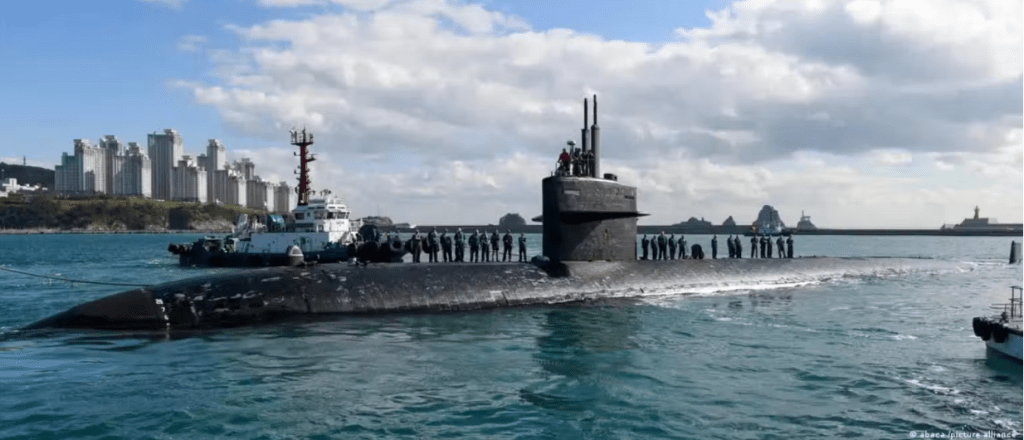
SEOUL, South Korea — Looking to drastically upgrade its naval deterrence against rapid, hostile weapons development right across its borders, Seoul has launched a historic defense directive. The South Korean government has officially unveiled a highly anticipated roadmap to develop and build its first-ever fleet of nuclear-powered attack submarines.
Defense Minister Ahn Gyu-back introduced the initiative, officially named the Jangbogo-N Project, during a meeting of the Future Defense Strategy Committee at the naval base in Jinhae. The ministry formally classified the defense acquisition as an essential “national strategic project.”
The decision to push for nuclear propulsion is driven by a widening military buildup in Northeast Asia. The strategic calculation centers on severe regional security vulnerabilities and the inherent limits of conventional fleets:
                  [ STRATEGIC DEFENSE FUNNEL ]
                               │
       ┌───────────────────────┴───────────────────────┐
       ▼                                               ▼
 [ REGIONAL THREAT FACTORS ]                     [ MECHANICAL ADVANTAGES ]
 • **The North Korean Threat:** Rapid advances   • **Endless Endurance:** Unlike diesel variants
   in hostile submarine-launched ballistic         that must surface frequently to snorkel, nuclear
   missiles (SLBMs).                               propulsion allows months of submerged tracking.
 • **The China Incursion:** Rising, unmapped     • **The Speed Multiplier:** Drastically increased
   maritime penetrations into sensitive territorial  transit velocity to intercept targets before they
   waters throughout the West Sea.                 can establish launch positions.
The defense ministry explicitly highlighted that these assets will form a vital leg of an “underwater kill chain”—a high-compute tracking matrix engineered to detect, shadow, and neutralize hostile ballistic platforms before they can slip into open water.
Because the term “nuclear” immediately raises non-proliferation questions on the global stage, the roadmap outlines highly specific boundaries to separate its propulsion ambitions from any nuclear weapons program.
                            [ JANGBOGO-N ROADMAP ]
                                       │
         ┌─────────────────────────────┴─────────────────────────────┐
         ▼                                                           ▼
   [ METRIC TARGET CALENDAR ]                                  [ NON-PROLIFERATION BOUNDS ]
   • **Mid-2030s:** Targeted launch window for the first operational • **Low-Enriched Uranium:** The reactors will rely entirely on
     indigenous hull.                                                 civilian-grade low-enriched uranium fuel.
   • **Late-2030s:** Projected timeline for full combat readiness    • **IAEA Safeguards:** Seoul has pledged to coordinate with the
     and open deployment.                                             International Atomic Energy Agency to maintain total visibility.
   • **Service Lifecycle:** Each vessel is planned to carry a         • **The Treaty Fence:** The government re-verified its absolute
     30-year active structural lifespan.                              commitment to international non-proliferation treaties.
The development represents a major shift in Washington’s regional strategy. U.S. President Donald Trump has officially greenlit the initiative, with the United States pledging technical support for the propulsion system’s development. While early bilateral summit notes from October initially suggested building the hulls in Philadelphia, the finalized roadmap clarifies that the submarines will be constructed natively in South Korean shipbuilders.
| Leading Industrial Ticker | Intraday Market Response | Core Operational Contribution |
| Hanwha Ocean | Stock values surged 10.2% | Heavily positioned to capture master design, structural integration, and heavy hull fabrication contracts. |
| HD Hyundai Heavy Industries | Stock values climbed 9.6% | Slated to lead localized marine engineering modules and heavy assembly logistics. |
Defense experts emphasize that this dual-sector initiative will merge South Korea’s world-class commercial shipbuilding capacity with its civilian nuclear energy infrastructure, opening an alternative lane to reprocess and manage domestic nuclear waste. By transforming itself into a “threshold nuclear power” with full American backing, Seoul intends to firmly secure its maritime borders, proving to its immediate neighbors that it is prepared to shoulder the full weight of its own regional defense infrastructure through the coming decades.