
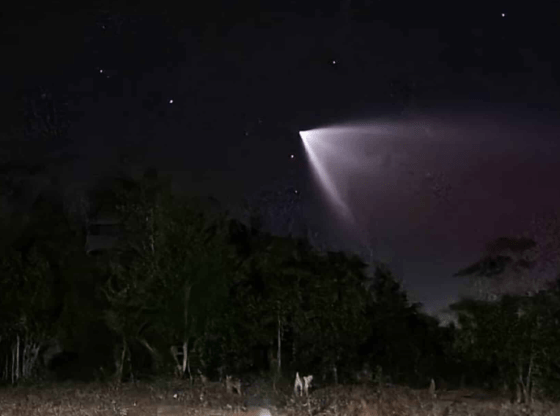

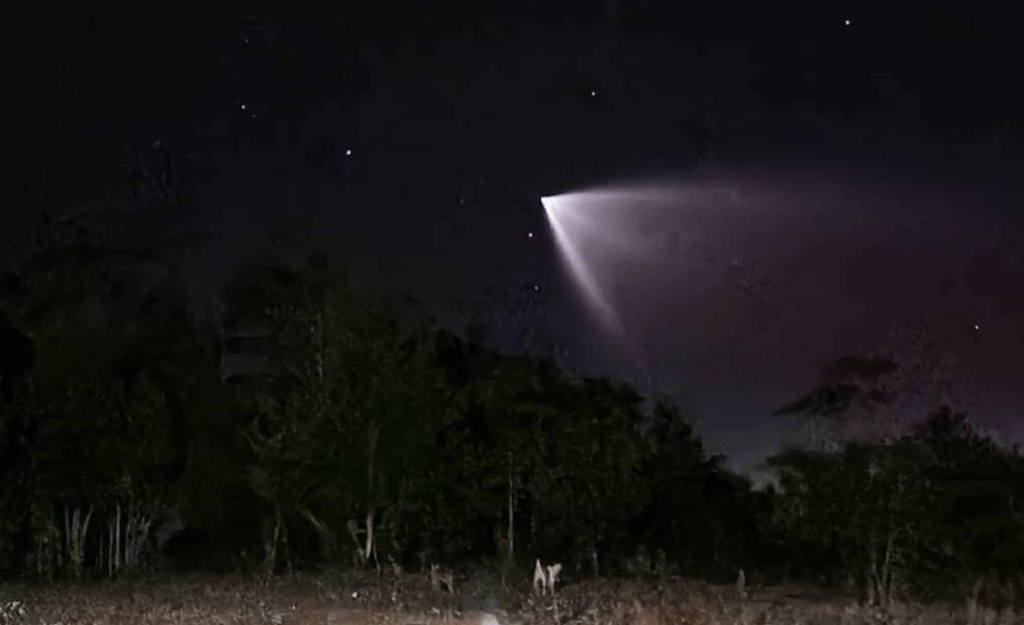
MANILA, Philippines — Glowing, jellyfish-like lights were spotted across several parts of the Philippines on the evening of Tuesday, May 12, 2026 the mysterious phenomenon was “highly likely” the result of a rocket launch from China.
The Philippine Space Agency (PhilSA) quickly issued an advisory to clarify that the sighting was not a UFO or a comet, but a rare atmospheric event known as a “space jellyfish.”
This visual spectacle occurs due to a specific combination of high-altitude physics and lighting:
- The Cause: It is created by the exhaust plume of a rocket. As the rocket reaches the thin upper atmosphere, the gases in its plume fan out in a wide, bulbous shape.
- The Glow: While observers on the ground are in darkness (post-sunset), the rocket at high altitude is still in the path of direct sunlight. The sun illuminates the expanding exhaust trail, making it appear as a luminous, glowing “jellyfish” against the dark sky.
- The Source: PhilSA identified the culprit as the Long March 6A (Chang Zheng 6A) rocket, which was launched from the Taiyuan Satellite Launch Center in northern China at approximately 7:58 p.m. (Manila time) on Tuesday.
- Time of Sighting: Roughly 8:10 p.m., approximately 12 minutes after the Chinese launch.
- Visibility: The glow was reported by residents in various regions, with clear photos surfacing from observers like Rachiel Batutay Bolaljog, whose images were featured in the PhilSA advisory.
- Debris Risk: Unlike previous Chinese rocket launches that triggered warnings about falling debris in the West Philippine Sea or near Palawan, PhilSA confirmed that no debris drop zones from this specific launch were projected over Philippine territory or waters.
This is not the first time Filipinos have witnessed this celestial display. A similar “space jellyfish” was observed in April 2026 following the launch of a Jielong-3 rocket from a sea-based platform in the South China Sea.
As China ramps up its satellite deployment schedule for 2026—including its own massive internet satellite megaconstellations—PhilSA expects these sightings to become more frequent.
The sighting comes at a busy time for the Philippine Space Agency, which recently marked the 10th anniversary of Diwata-1 (the country’s first microsatellite) and is currently monitoring air quality and crop damage from recent Mayon Volcano ashfall using satellite data.