
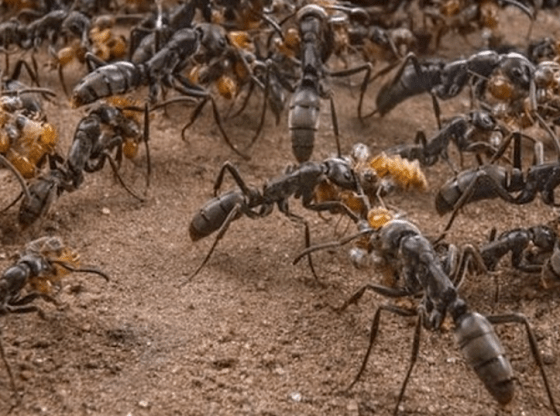

In a remarkable display of medical intervention, Florida carpenter ants (Camponotus floridanus) have been observed performing limb amputations on their injured nestmates to improve their survival chances. This behavior, documented by researchers, marks the first known instance of a non-human species using such a technique to save another’s life.
In laboratory studies at the University of Würzburg, Germany, led by entomologist Erik Frank, these ants treated injuries by either cleaning the wound with their mouthparts or amputating the damaged limb through biting, depending on the injury’s location. If the injury was higher up the leg, amputation was preferred; if lower, they opted for cleaning.
“In this study, we describe how ants use amputations to save lives,” said Frank. “Their ‘medical system’ is the most sophisticated in the animal kingdom, rivaled only by humans.”
The researchers found that the ants’ decision-making was influenced by the flow of hemolymph—the invertebrate equivalent of blood. Injuries further up the leg had a slower hemolymph flow, allowing time for amputation, while injuries lower down had faster hemolymph flow, making immediate cleaning more effective.
The survival rate for ants receiving amputations was about 90-95%, compared to 40% for those left unattended. For lower leg injuries treated by cleaning, the survival rate was around 75%, versus 15% for untreated injuries.
Interestingly, this care was observed only among female worker ants, as males have a minimal role in the colony.
“This behavior suggests an evolutionary advantage,” Frank noted. “By rehabilitating an injured worker, the colony conserves resources and maintains productivity. However, severely injured ants are abandoned, indicating a pragmatic approach to colony survival.”