
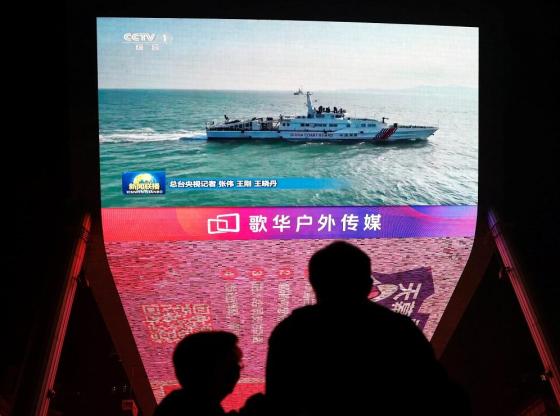

BEIJING/TAIPEI — The war of words between China and Taiwan intensified this week as both sides clashed over their opposing historical narratives and claims to sovereignty, with Beijing insisting it cannot “invade” what it already considers Chinese territory.
China, which views the self-governed island of Taiwan as part of its territory, has increased military and political pressure on Taipei in recent years. Its hostility has grown under Taiwan President Lai Ching-te, whom Beijing labels a separatist.
In a series of speeches titled “Uniting the Country,” Lai reaffirmed Taiwan’s status as an independent nation, asserting, “Taiwan is, of course, a country,” and argued that China lacks any legal or historical right to claim the island.
In response, Zhu Fenglian, spokesperson for China’s Taiwan Affairs Office, warned on Wednesday that any push for independence from Lai’s administration would be met with “resolute countermeasures.” She stressed that both sides of the Taiwan Strait share a historical and cultural bond under the concept of “one China.”
While tensions remain high, including frequent Chinese military operations near Taiwan, Zhu denied the notion of a possible invasion. “Taiwan is a part of China; there is no invasion to speak of,” she said.
President Lai, however, argued that Taiwan’s future must be determined democratically by its people. In a Tuesday speech, he highlighted the historical lineage of Taiwan’s government, noting that the Republic of China, which relocated to Taiwan in 1949, is over 100 years old—far older than the People’s Republic of China.
Taiwan’s Defense Minister Wellington Koo also weighed in, accusing Beijing of manipulating history ahead of China’s upcoming World War II anniversary parade, which controversially invites veterans from Taiwan’s military past. “The Republic of China led and won the war against Japan,” Koo stated.
As both sides continue to assert their own historical legitimacy, the potential for greater regional tension remains high.