
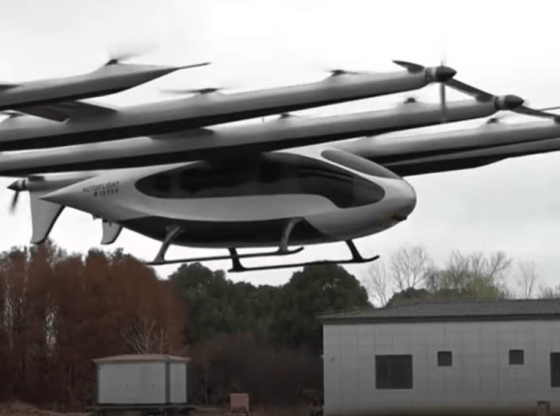

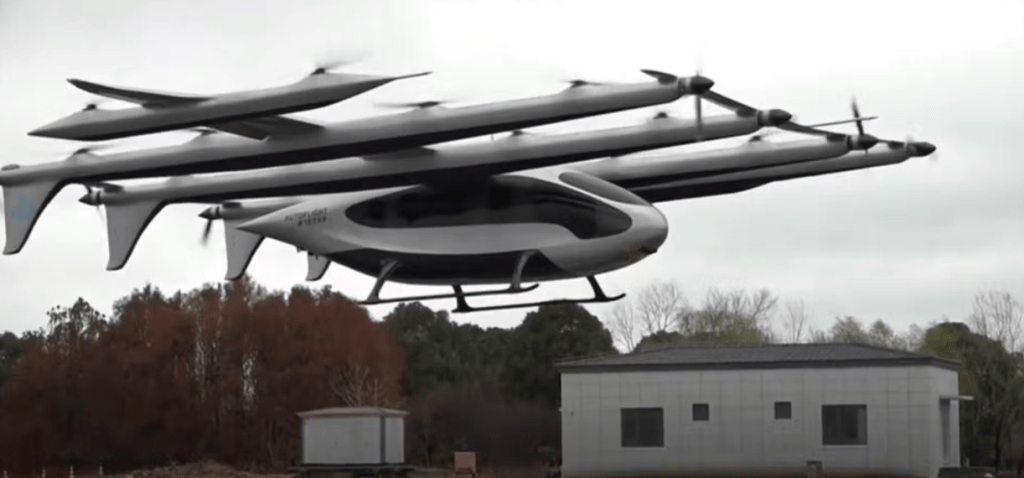
KUNSHAN, China — A glimpse into the future of urban air mobility took flight on March 5, 2026, as the Chinese aviation startup AutoFlight showcased its latest prototype, “The Matrix”—the largest electric vertical takeoff and landing (eVTOL) aircraft built in China to date.
The aircraft is designed to challenge the current business models of urban air taxis by offering significantly higher capacity and weight:
- Capacity: Capable of carrying up to 10 passengers (or 1,500 kg of cargo).
- Weight: A 5-ton class vehicle with a maximum takeoff weight of 5.7 metric tons.
- Dimensions: Features a 20-meter (66-foot) wingspan, is 17.1 meters long, and stands 3.3 meters tall.
- Performance: Can travel for approximately one hour on a single charge (fully electric range of ~250 km). A hybrid-electric version is envisioned to fly up to 1,500 km.
During a demonstration for the Associated Press in Kunshan (37 miles west of Shanghai), the Matrix successfully completed a transition flight. The aircraft rose vertically like a drone, transitioned into forward wingborne cruise flight for two circuits around the facility, and landed smoothly. Witnesses noted that while the rotors were audible, the noise level was significantly lower than that of a traditional helicopter.
Despite the successful flight, widespread “flying taxi” services remain several years away:
- Certification: AutoFlight hopes to receive a type certificate from aviation regulators by 2027, confirming the design meets safety standards.
- Ecosystem Challenges: Steven Yang, senior vice president of AutoFlight, noted that the “whole ecosystem”—including landing pads, charging stations, and air traffic management—must be developed alongside the technology.
- Expert Outlook: Gary Ng, a senior economist at Natixis, estimated it would take at least another three years to see a viable commercial operation.
The Matrix is part of a broader push by China to dominate the “low-altitude economy” (airspace below 1,000 meters). While companies like EHang have already secured certifications for smaller two-seater passenger drones, AutoFlight’s Matrix represents a shift toward larger, regional-scale transport that could eventually move as many people as a standard transit van.