
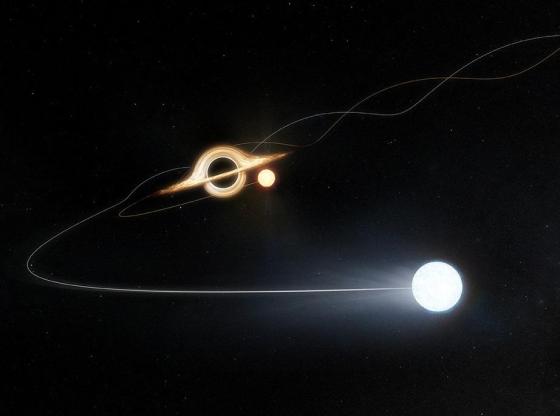

Scientists have uncovered compelling evidence of a supermassive black hole at the heart of the Large Magellanic Cloud (LMC)—a nearby dwarf galaxy visible from Earth’s southern hemisphere. This discovery was made by tracking nine hypervelocity stars ejected from the LMC, suggesting they were flung away by the immense gravitational pull of this black hole.
While most galaxies are believed to harbor supermassive black holes, this marks the first direct evidence of one within the LMC. At about 160,000 light-years away, it is now the closest known supermassive black hole outside the Milky Way, second only to Sagittarius A* (Sgr A*), the black hole at our galaxy’s center.
A Lightweight Giant
Compared to Sgr A*, which is 4 million times the mass of the Sun, this newly identified black hole is about 600,000 times the Sun’s mass, making it one of the least massive supermassive black holes known.
Hypervelocity Stars as Clues
The study focused on hypervelocity stars, which are created when a binary star system—two stars orbiting each other—wanders too close to a black hole. One star is captured, while the other is violently ejected at speeds thousands of kilometers per second.
Astronomers used data from the European Space Agency’s Gaia space observatory, which has mapped over a billion stars with unprecedented accuracy. Of the 21 known hypervelocity stars in the Milky Way, 16 have been traced back to their origins—seven to Sgr A* and the remaining nine to the LMC.
What’s Next?
While this discovery strongly suggests the LMC hosts a supermassive black hole, astronomers still need to pinpoint its exact location. The finding reshapes our understanding of the LMC and strengthens the theory that most galaxies, regardless of size, contain these cosmic giants at their centers.
“The Large Magellanic Cloud is one of the best-studied galaxies, yet this black hole’s existence was only inferred indirectly,” said Caltech astronomer Kareem El-Badry. “We have more work to do to locate it precisely.”