
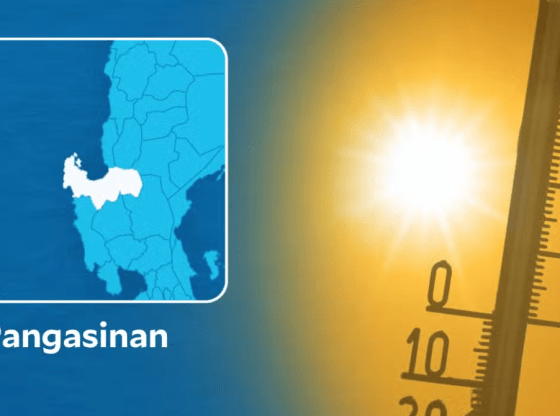


LINGAYEN, Pangasinan — Breaking previous records for seasonal discomfort, a blistering atmospheric wave has forced local authorities to raise maximum medical safety warnings. Pangasinan recorded its highest heat index of the year, peaking at an alarming 47 degrees Celsius (47°C) at 4:00 p.m. on Thursday, May 21.
The extreme measurement places the province squarely into the state-defined “Danger” category, indicating that prolonged exposure or physical exertion will likely trigger immediate heat-related medical emergencies.
Data monitored by the Pangasinan Provincial Disaster Risk Reduction and Management Office (PDRRMO) shows that the regional heat engine has been consistently accelerating over a multi-week span:
[April 27: Previous High of 46°C] ──► [May 20 & 25: Baseline Holds at 45°C] │ ▼ (The Peak: May 21, 2026)[47°C Heat Index Peak] ◄── Recorded at 4:00 PM via PAGASA Dagupan Station
According to meteorological logs from the Department of Science and Technology–PAGASA station in Dagupan, the heat index across the province has not dropped below 40°C since the start of April. The relentless thermal buildup creates an expansive, compounding burden on both human health and local power distribution networks.
The Department of Health (DOH) and weather officials utilize a specific scale to categorize apparent temperatures—the temperature the human body actually feels when combining relative humidity with ambient air temperatures:
                            [ APPULSIVE HEAT RISK MATRIX ]
                                          │
         ┌────────────────────────────────┴────────────────────────────────┐
         ▼                                                                 ▼
   [ 42°C TO 51°C: THE DANGER ZONE ]                                 [ THE PHYSICAL ANALOGY ]
   • Continuous environmental exposure at this tier poses a          • The PDRRMO illustrated that experiencing a 47°C index
     critically high risk of heat exhaustion, heat cramps, and          feels equivalent to sitting inside an unventilated car
     potentially fatal heat stroke.                                     parked directly in the sun.
   • High humidity prevents sweat from evaporating efficiently,      • Alternatively, it mimics standing directly in front of a
     crippling the body's natural cooling mechanisms.                   high-capacity, commercial hot-air blower.
To prevent an unmanageable spike in emergency room admissions, provincial health offices have issued urgent behavioral mandates for residents, outdoor workers, and students across the region:
- Continuous Rehydration: Carry potable water at all times. Drink regularly and in large volumes, even if you do not actively feel thirsty, to prevent severe dehydration.
- The Midday Shelter Rule: Limit non-essential outdoor travel and strenuous physical activities between 10:00 a.m. and 3:00 p.m., when solar radiation spikes to its most intense levels.
- Thermal Protection: If outdoor tasks are unavoidable, wear loose, lightweight, light-colored clothing and utilize umbrellas, wide-brimmed hats, or sunblock.
Local government executives are currently keeping an eye on water utility pressure baselines, warning that seasonal water allocation shortages must not be allowed to compound what is already a punishing environmental crisis for the province.