
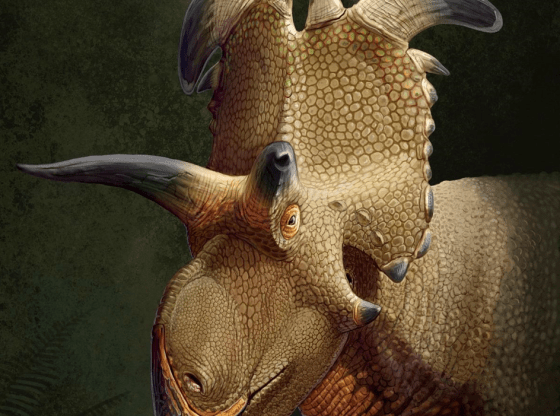

WASHINGTON — About 78 million years ago, in the lush subtropical plains now known as the badlands of northern Montana, a unique horned dinosaur roamed. Dubbed Lokiceratops rangiformis, this 22-foot-long, 5.5-ton plant-eater is a fascinating new discovery in paleontology.
Lokiceratops, named for its blade-like horns reminiscent of the Norse god Loki’s weaponry, featured an array of impressive headgear. It had two 16-inch curving horns above its eyes, smaller cheek horns, and an elaborate frill adorned with at least 20 horns, including an asymmetrical pair of two-foot-long, blade-shaped ones—the largest ever found on a dinosaur.
The name Lokiceratops, meaning “Loki’s horned face,” also honors the Museum of Evolution in Denmark, the fossils’ permanent home. The frill’s diverse horn lengths evoke caribou antlers, inspiring its scientific nomenclature.
Paleontologist Joe Sertich of the Smithsonian Tropical Research Institute and co-author of the study published in PeerJ, noted that Lokiceratops’ horns and frill were likely used for display to intimidate rivals, attract mates, or identify species members. Unlike many ceratopsians, Lokiceratops lacked a nose horn, suggesting its horns were not primarily for defense.
Discovered two miles south of the U.S.-Canada border, Lokiceratops inhabited a coastal plain with forests, lakes, and swamps on the eastern edge of Laramidia. It coexisted with other horned dinosaurs, including close relatives Medusaceratops and Albertaceratops, as well as the duck-billed Probrachylophosaurus and a large carnivorous dinosaur related to T. rex.
Mark Loewen, paleontologist and co-author from the University of Utah, emphasized the rarity of finding five ceratopsian species in one ecosystem. This discovery challenges the previous belief that only two could coexist, revealing rapid evolution and unexpected diversity among centrosaurines in this region.
“This discovery parallels patterns in mammalian evolution seen in Africa with antelope and buffalo,” Sertich added, highlighting the remarkable richness of the ancient ecosystem.
Tags: dinosaurs, paleontology, Norse mythology