
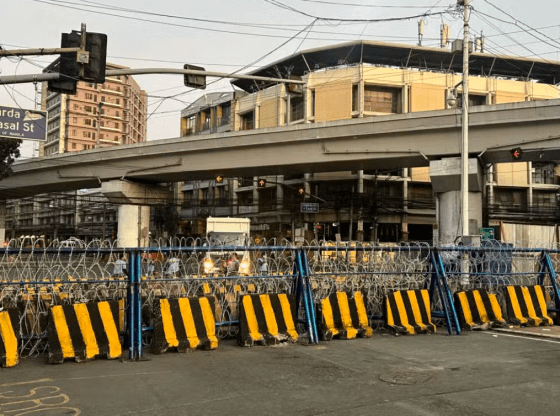


MANILA – In a stark visual of preemptive fortification amid rising public outrage over graft scandals, Manila authorities have sealed off the historic Mendiola Peace Arch with towering shipping containers and coils of barbed wire, effectively barricading one of the city’s most symbolic protest sites ahead of massive anti-corruption rallies slated for November 30, 2025. The heavy-handed setup, which transformed the bustling gateway into a makeshift fortress overnight, underscores the tension gripping the capital as demonstrators gear up for what could be the largest outcry against alleged government plunder since the September 21 mobilizations.
The barriers, positioned strategically around the arch – a enduring emblem of the 1986 People Power Revolution – were spotted early Saturday, blocking pedestrian and vehicular access from the Quiapo side. Eyewitnesses described the scene as surreal: Massive blue shipping containers stacked like urban monoliths, topped with razor-sharp barbed wire that gleamed ominously under the morning sun, creating an impenetrable wall that funnels any would-be protesters into narrower, policed lanes. “It’s like they’re preparing for war, not words,” remarked one local vendor near the site, who watched as National Capital Region Police Office (NCRPO) teams fine-tuned the fortifications. The arch, long a launchpad for landmark marches from farmers’ uprisings to anti-dynasty drives, now stands as a silent sentinel, its peace motif juxtaposed against the steel sentinels.
The Philippine National Police (PNP) has mobilized over 15,000 officers across Metro Manila to maintain order during the weekend’s dual demonstrations, with PNP chief Gen. Rommel Marbil emphasizing a “maximum tolerance” approach while prioritizing public safety. “We respect the right to assemble, but we must prevent any escalation that could endanger lives or property,” Marbil stated in a pre-dawn briefing, confirming the Mendiola blockade as a “proactive measure” to channel crowds away from high-traffic zones. NCRPO Director Nicolas Torre III echoed the sentiment, noting that similar setups – including concrete barriers along Padre Burgos Street – were in place to avoid repeats of past clashes. No arrests were reported during the setup, but tensions simmered as early-bird activists tested the perimeters, snapping photos that quickly flooded social media under hashtags like #MendiolaBlocked and #TrillionPesoMarch.
The fortifications come on the eve of two powerhouse protests: The Trillion Peso March, spearheaded by the Trillion Peso March Movement (TPMM), is set to converge at the People Power Monument in Quezon City, drawing labor unions, fisherfolk, and faith groups in white attire to demand the unmasking of corrupt officials and the recovery of plundered funds. Simultaneously, the People’s Movement Against Corruption’s “Baha sa Luneta 2.0” – a nod to the September deluge of dissent – aims to flood Rizal Park with calls for jail time for graft kingpins, backed by 86 Catholic dioceses urging Masses and marches as acts of moral renewal. Organizers, including Bayan Secretary-General Mong Palatino, decried the Mendiola move as “overreach,” linking it to the earlier halt of Luneta prep due to a permit snag. “They’re not just blocking roads; they’re barricading justice,” Palatino fumed, vowing an undimmed turnout despite the hurdles.
This isn’t Manila’s first rodeo with rally-ready ramparts – echoes of 2016’s jeepney strikes and 2020’s anti-terror law demos linger – but the timing bites deeper amid the flood control scandal’s fresh wounds. The P20-billion fiasco, riddled with ghost projects and kickbacks implicating lawmakers and contractors, has left communities vulnerable and coffers cracked, fueling a national thirst for transparency. With the Department of the Interior and Local Government (DILG) greenlighting the events from 6 a.m. to 6 p.m., and a joint task force of 15,000 PNP personnel blanketing hotspots, Sunday’s script could swing from serene solidarity to simmering standoff.
As the sun climbed higher over the coiled wire, a small cluster of passersby paused at the arch’s edge, murmuring prayers and snapping selfies against the steel backdrop. For them, and the multitudes marching, Mendiola’s blockade isn’t a barrier – it’s a battle cry, a stark reminder that in the Philippines’ perennial push for purity, even peace arches must sometimes stand guarded. With Edsa’s echoes and Luneta’s legacy in play, November 30 looms as a litmus test: Will the walls hold back the tide, or will the people’s power flow around them?