
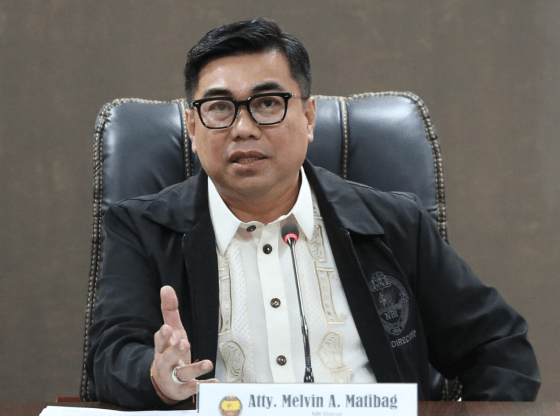


MANILA, Philippines — Pointing to a critical gap in the country’s cyber-defense matrix, the nation’s top investigative body is urging lawmakers to establish strict legislative barriers against digital manipulation. The National Bureau of Investigation (NBI) is formally asking Congress to pass a law granting authorities a clear legal framework to monitor and prosecute social media troll farms, fake accounts, and deceptive artificial intelligence (AI) deepfakes.
Speaking during the Saturday News Forum at Dapo Restaurant in Quezon City, NBI Director Melvin Matibag emphasized that while existing laws adequately cover traditional cybercrimes like digital financial fraud, they leave law enforcement completely empty-handed when dealing with organized disinformation networks.
Director Matibag explained that under current laws, enforcement metrics are only clear-cut when fake accounts are directly tied to traditional malicious schemes:
[Fake Accounts Linked to Scams / Fraud] ──► Explicitly Actionable Under Cybercrime Prevention Act (2012) │ ▼ (The Current Operational Gap)[Organized & Coordinated Troll Farms] ◄── Systemic Lack of Specific Legal Cover or Monitoring Basis │ ▼ [Trolls Artificially Dignify False Narratives]
“We’re always hearing about troll farms. But we have no legal basis or legal cover to go after troll farms,” Matibag stated. He noted that troll operations present a unique threat because they rely on coordinated behavior designed to make a singular, manufactured narrative look organic, credible, and widely accepted by the public. The issue multiplies exponentially when real users unknowingly pick up and spread these coordinated falsehoods through legitimate profiles.
Despite operating without a dedicated legislative mandate for troll operations, the NBI continues to conduct aggressive day-to-day cleanup operations in direct partnership with big tech platforms:
                            [ NBI DIGITAL CLEANUP METRICS ]
                                           │
         ┌─────────────────────────────────┴─────────────────────────────────┐
         ▼                                                                   ▼
   [ META TECH COORDINATION ]                                          [ RECOVERY & CASE TRACKING ]
   • Over **2,000 completely identity-less fake profiles** have         • A portion of the individuals behind the deactivated profiles
     been scrubbed since Matibag assumed office.                         are already facing standard criminal charges.
   • The bureau maintains a highly supportive, daily automated         • Remaining network operators are under active, ongoing forensic
     takedown workflow alongside Meta systems.                           investigation by cyber-teams.
A major driver behind the NBI’s urgent push toward Congress is the unchecked explosion of sophisticated AI-generated content. Matibag confirmed that regulating AI-generated videos and images—specifically those engineered to make individuals appear in scenes or make statements they never actually did—will be a core pillar of the NBI’s legislative proposal.
| Emerging Threat Vector | NBI Assessment & Regulatory Position | Core Strategic Objective |
| AI Deepfakes & Synthetics | Represents a direct, severe violation of individual privacy rights, regardless of whether the portrayal is malicious or positive. | Wants explicit statutory powers to regulate, track, and penalize unauthorized deepfake generation. |
| Former POGO Scam Hubs | Fragmented remnants of collapsed Philippine Offshore Gaming Operations are actively transitioning into specialized love scams and financial fraud networks. | Handled via aggressive enforcement of the Cybercrime Prevention Act of 2012. |
To match the rapidly evolving digital landscape, Matibag revealed that the bureau is concurrently procuring advanced automated detection systems to actively track down and dismantle coordinated network operations. However, the NBI chief maintained that technical tools are merely a stopgap. Until Congress passes a definitive law regulating AI synthetics and criminalizing coordinated network deception, the country’s information ecosystem will remain highly vulnerable to synthesized manipulation.