
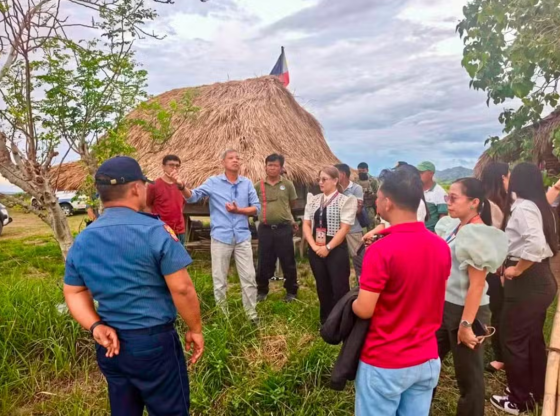

TABUK CITY, Kalinga — To protect the earliest known evidence of human presence in the Philippines, heritage authorities and local leaders have launched an emergency campaign to seal off a world-class historical landmark. Officials from the National Museum of the Philippines (NMP) and the Kalinga provincial government have drastically intensified security operations around Elephant Hill.
The urgent push follows an expansive multi-agency ocular inspection on Monday, June 8, 2026, which revealed that the pre-historic treasure trove is facing imminent, modern-day destruction.
Situated in Sitio Greenhills, Barangay San Pedro within the municipality of Rizal, Kalinga, Elephant Hill has transformed into an archaeological battleground. The composite inspection team—which included Rizal Mayor Karl Baac alongside delegates from the police, the Department of Environment and Natural Resources (DENR), and the Department of Agrarian Reform (DAR)—uncovered severe structural threats:
                          [ THE ANTHROPOGENIC THREATS TO ELEPHANT HILL ]
                                                │
         ┌──────────────────────────────────────┴──────────────────────────────────────┐
         ▼                                                                             ▼
   [ REVENUE-DRIVEN EXCAVATIONS ]                                                [ AGRICULTURAL ENCROACHMENT ]
 • **The Rise of Looting:** Investigators documented a spike in      • **Irreversible Grading:** Massive patches of the protected
   unauthorized diggings and artifact looting, driven by black-market • perimeter are actively being cleared and converted for localized
   demands for ancient fossils.                                      • commercial farming.
 • **Loss of Historical Context:** Wild, unscientific trenching      • **Tearing Down the Past:** Deep plowing and soil grading threaten
   permanently destroys the layered soil strata used to date finds.  • to crush subsurface megafauna skeletal deposits.
The reason scientists are fiercely defending this specific patch of Kalinga land centers on a groundbreaking 2018 French-Filipino excavation. The discoveries made at Elephant Hill completely shattered previous academic timelines regarding human migration in Asia:
[ THE ELEPHANT HILL GEOLOGICAL RECORD ] │ ▼[ The 709,000-Year Timestamp ]──► Advanced chemical and physical dating methods proved that the site's artifacts are roughly **709,000 years old**. │ ▼[ Pre-dating Callao Cave ] ──► Before this find, the oldest evidence of Philippine human activity stuck at 67,000 years ago (Callao Cave, Cagayan). Elephant Hill pushed the timeline back by over 600,000 years. │ ▼[ The Butchered Rhinoceros ] ──► Uncovered 57 stone tools alongside a 75% intact fossil of an extinct rhino (*Nesorhinus philippinensis*). The bones bear clear percussion marks, proving early hominids butchered it.
The Extinct Eco-System: Beyond the rhinoceros, layers of the hill have yielded fossilized remains of stegodons (an ancient, tusked relative of the elephant), giant monitor lizards, box turtles, and the extinct Philippine brown deer.
First declared an archaeological reserve by President Ferdinand Marcos Sr. in 1977, the National Museum formally elevated the site to a National Cultural Treasure in 2023. While select premier fossils are currently housed at the National Museum of Natural History in Manila, local leaders want to anchor the economic and educational benefits right in Kalinga.
To combat the wave of illegal looting and land conversion, Mayor Baac and the provincial board finalized a two-pronged defensive strategy:
- Inter-Agency Enforcement: Deploying regular police patrols and DENR forestry rangers to arrest unauthorized diggers and halt illegal land titles within the 16-square-kilometer archaeological zone.
- A Localized Research Hub: Fast-tracking plans to construct a dedicated, secure local research center and community museum inside Rizal town to store newly excavated materials and safely showcase the prehistoric findings to residents and visiting tourists.