
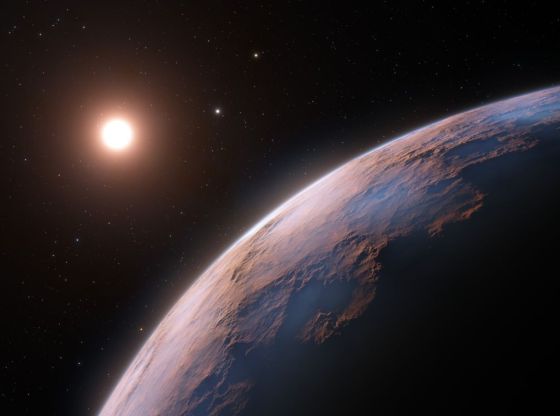

WASHINGTON – The exoplanet HD 189733b, known for its extreme conditions, has gained a new, pungent distinction. Researchers have detected hydrogen sulfide, the chemical responsible for the stench of rotten eggs, in its atmosphere using data from the James Webb Space Telescope.
Discovered in 2005, HD 189733b is a hot gas giant slightly larger than Jupiter. It is famous for its cobalt blue color and glass rain driven by fierce winds. The presence of hydrogen sulfide adds to its notorious reputation.
“This stinky smell certainly adds to its infamy. While it’s not a place humans would want to visit, it offers valuable insights into planetary science,” said Guangwei Fu, an astrophysicist at Johns Hopkins University and lead author of the study published in Nature.
HD 189733b is classified as a “hot Jupiter,” orbiting its host star 170 times closer than Jupiter does to the sun, completing an orbit every two days. This proximity results in extreme temperatures of about 1,700 degrees Fahrenheit (930 degrees Celsius) on the star-facing side.
“Hot Jupiters are quite rare, found in less than 1% of star systems,” Fu added. Located 64 light-years from Earth in the constellation Vulpecula, this exoplanet’s relative proximity allows for detailed studies that would be more challenging for more distant planets.
The planet’s host star is smaller, cooler, and less luminous than our sun and is part of a binary system. The James Webb Space Telescope, operational since 2022, offers broader wavelength observations, enabling a more comprehensive analysis of exoplanet atmospheres.
“Our research reveals that HD 189733b is more similar to Jupiter than previously thought,” said Luis Welbanks, an astrophysicist at Arizona State University and study co-author. Like Jupiter, HD 189733b has trace amounts of hydrogen sulfide. It also contains water and carbon dioxide, as earlier data suggested.
“These three molecules allow us to measure the planet’s oxygen, carbon, and sulfur, helping us understand its formation and how it compares to planets in our solar system,” Welbanks explained. The observations also ruled out methane in the atmosphere.
“Understanding the composition of exoplanets like HD 189733b helps us contextualize our solar system’s uniqueness,” Welbanks concluded. “While we aren’t searching for life on this inhospitable planet, studying its atmosphere helps us understand planetary formation and the behavior of physics and chemistry in different environments.”