
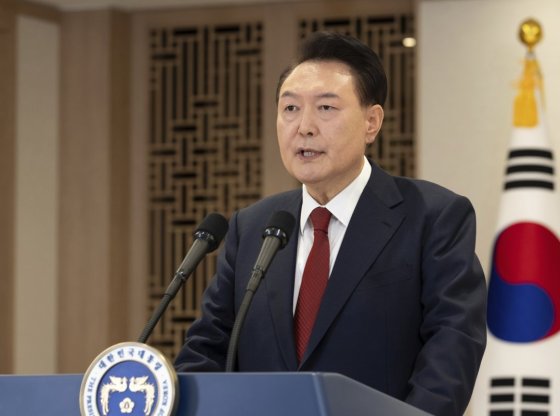

Embattled South Korean President Yoon Suk Yeol pledged to resist impeachment efforts, declaring in a televised address that he would “fight to the end” as his political party moved closer to supporting his removal over his brief martial law declaration earlier this month.
Martial Law Controversy
Yoon’s leadership has been under intense scrutiny since his December 3 martial law order, which was quickly rescinded but sparked South Korea’s most significant political crisis in decades. The move was ostensibly aimed at addressing alleged interference by North Korea in the country’s election commission, but it faced widespread criticism for undermining democratic principles.
Rift Within Yoon’s Party
In a dramatic turn, Han Dong-hoon, leader of Yoon’s ruling People Power Party (PPP), suggested the party align with the opposition to impeach the president.
“His address was akin to confessing to insurrection,” Han said, signaling growing fractures within the party.
Jin Jong-oh, another PPP lawmaker, also voiced support for impeachment, bringing the number of defectors to seven—one short of the eight PPP votes needed for the opposition-led impeachment to achieve a two-thirds majority in parliament.
Despite the rift, a majority within the PPP continues to back Yoon. In a show of internal support, the party elected Kweon Seong-dong, a close political ally of Yoon, as its assembly leader. Kweon reaffirmed the party’s stance against impeachment.
Impeachment Process and Potential Limbo
If impeachment passes, the case would be sent to South Korea’s Constitutional Court, initiating a months-long process to determine Yoon’s legitimacy. This would leave Asia’s fourth-largest economy in political limbo, further straining governance and policymaking.
Criminal Investigations
Yoon also faces a criminal investigation for alleged insurrection related to his martial law declaration. Opposition leaders accused Yoon of using emergency powers to consolidate authority and disrupt the democratic process, calling his address “a display of extreme delusion.”
North Korean Hacking Allegations
In his address, Yoon accused North Korea of hacking the National Election Commission (NEC) to influence the April 2024 elections, which resulted in a landslide defeat for his party. However, he provided no concrete evidence.
Yoon justified his martial law order as a “symbolic” act meant to expose opposition plots to “destroy the country” and undermine its alliance with the United States. The NEC denied claims of election manipulation, asserting that such interference was “effectively impossible.”
Opposition Push for Accountability
The opposition Democratic Party, which holds a supermajority in the assembly following April’s elections, has consistently challenged Yoon’s policies and alleged government wrongdoing. Kim Min-seok, a Democratic Party leader, called on PPP members to support impeachment to “restore democratic order.”
Political Uncertainty
With a second impeachment vote set for Saturday, South Korea remains on edge as the country’s leadership battles a deepening crisis that could reshape its political landscape.