
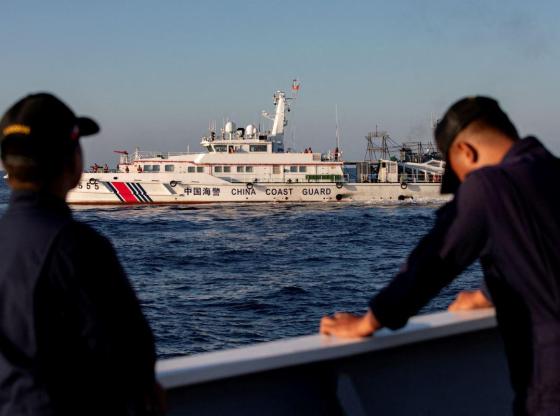

In a recent statement, a top US admiral suggested that American naval vessels could potentially escort Philippine ships during their resupply missions in the South China Sea. Admiral Samuel Paparo, head of the US Indo-Pacific Command, described this as a “reasonable option” under the Mutual Defense Treaty between the two nations. This option, however, would require consultation between the allies.
The statement comes amid rising tensions between the Philippines and China, following a series of maritime and aerial confrontations in the region. China has continued to assert its claim over the South China Sea, a key trade route with more than $3 trillion worth of goods passing through annually. Meanwhile, the Philippines has persisted in its supply efforts to a grounded naval ship on the contested Second Thomas Shoal, also known as Ayungin Shoal.
When asked if the US might consider escorting Philippine ships in disputed areas, Paparo affirmed that it was a possibility, stressing that such a move would be “within the context of consultations” under the Mutual Defense Treaty.
However, General Romeo Brawner, Chief of the Armed Forces of the Philippines, expressed a preference for conducting these missions independently, despite China’s “dangerous” and “coercive” tactics. He emphasized that the Philippines would explore all available options to ensure the success of their missions, including potential cooperation with other nations beyond the US.
The 1951 Mutual Defense Treaty obligates the US to defend the Philippines in the event of armed attacks on its forces, ships, or aircraft in the South China Sea. Philippine Defense Secretary Gilberto Teodoro called for a broader interpretation of this treaty to address the evolving nature of threats in the region. He also urged regional countries to condemn China’s actions, which he described as the “biggest disruptor of peace.”
Despite a 2016 international tribunal ruling that invalidated China’s extensive claims over the South China Sea, Beijing has rejected the decision and continues to assert sovereignty over nearly the entire region, contested by several Southeast Asian nations.