
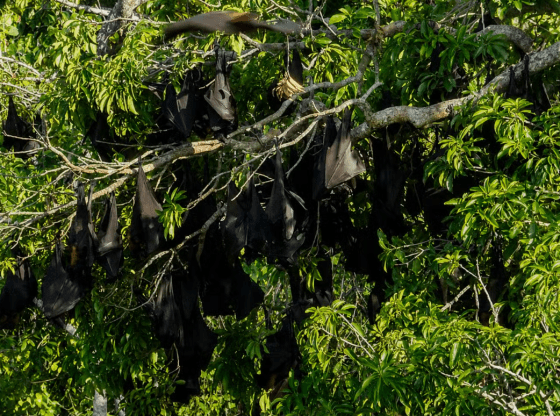

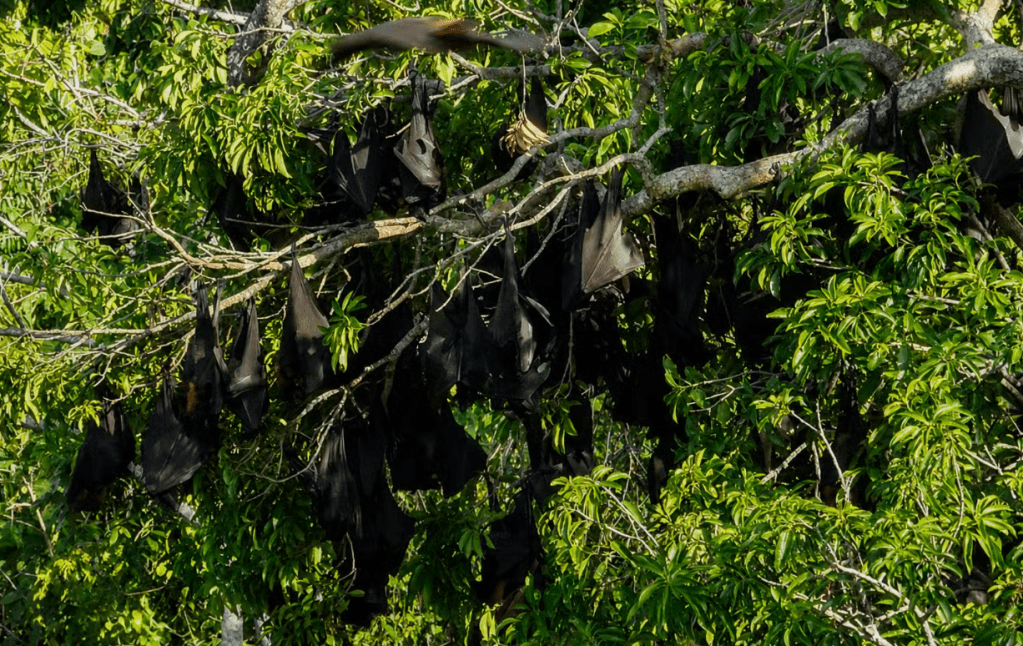
BANISILAN, COTABATO — Environmental monitors have documented a massive wildlife concentration deep within the mountains of Mindanao. A comprehensive wildlife survey has successfully recorded approximately 160,000 flying foxes (fruit bats) roosting in a forest in Banisilan, Cotabato, highlighting a major victory for regional biodiversity.
The two-day population count and roost site assessment was spearheaded by the Department of Environment and Natural Resources (DENR) SOCCSKSARGEN via the Community Environment and Natural Resources Office (CENRO) Midsayap. The field tracking was conducted in close coordination with the Municipal Environment and Natural Resources Office (MENRO), local barangay units, and on-the-job training volunteers from Notre Dame of Midsayap College.
The extensive field monitoring identified a diverse, thriving population sharing the same forest sanctuary. The census confirmed the presence of three distinct bat species:
- The Golden-Crowned Flying Fox (Acerodon jubatus): Listed as critically endangered, this endemic species ranks among the largest bat species in the entire world and exists exclusively in the Philippine archipelago.
- The Large Flying Fox (Pteropus vampyrus): Categorized globally as endangered, these giant fruit bats play a massive role in maintaining lowland forest ecosystems.
- The Island Flying Fox (Pteropus hypomelanus): Known for its distinct traveling boundaries, this species rounds out the diverse Banisilan colony.
Beyond the raw population count, researchers documented an unusually high volume of juvenile bats within the clusters, confirming that the forest area serves as a vital, highly active breeding and nursery habitat.
The joint conservation team monitored the fly-out counts and nighttime dispersal patterns, revealing a highly coordinated biological schedule:
- The Departure Phase: The massive fly-out routinely triggers around 5:30 p.m. as the sun begins to dip.
- The Peak Dispersal: The migration reaches its absolute peak at around 5:50 p.m., creating a striking visual phenomenon where hundreds of bats per second fill the sky, forming sweeping, dense silhouettes until nightfall.
- Behavioral Shift: Biologists noted a significant behavioral change compared to older historical surveys. The fruit bats are now navigating at significantly higher altitudes above the forest canopy, a shift from their previous low-level flight patterns. Experts suggest this could point to changing weather elements, predator avoidance, or structural adaptations to the surrounding canopy.
Environmental officials emphasize that protecting the sanctuary at Sitio Kalantay goes far beyond saving an isolated species. Flying foxes are widely regarded by conservation scientists as “silent reforesters” or the primary mechanics of tropical ecosystems.
Because they are among the very few animals capable of consuming and carrying large seeds across fragmented landscapes, mountain ridges, and rivers, their natural seed dispersal and pollination patterns are completely indispensable for tropical forest regeneration, watershed health, and long-term climate resilience.
With the massive Banisilan colony declared stable and actively reproducing, the DENR has called for strict local enforcement under the Wildlife Resources Conservation and Protection Act (RA 9147) to completely insulate the habitat from illegal logging, mining, agricultural expansion, and wildlife poaching.