
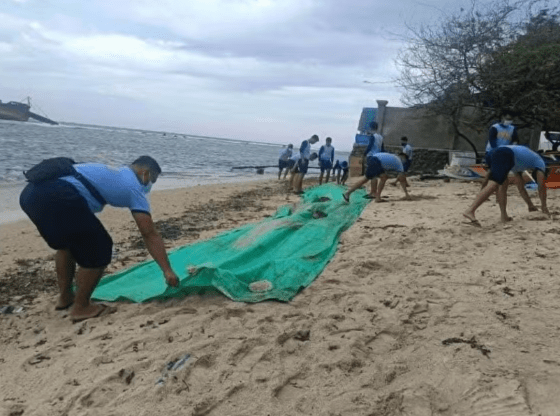


CALASIAO, Pangasinan — Bringing vital ecological and economic reassurance to the northern coastline, marine scientists have confirmed that a recent maritime accident has not triggered a localized biological collapse. The Bureau of Fisheries and Aquatic Resources (BFAR) announced that zero fish kill incidents have been recorded following an oil spill off the coast of Ilocos Norte.
Environmental response teams have effectively removed visible surface contaminants, limiting the immediate ecological fallout.
The environmental emergency began early in the week due to severe monsoon weather, transitioning rapidly from an industrial stranding to a complete vessel submergence:
                          [ THE BADOC, ILOCOS NORTE WRACK PIPELINE ]
                                              │
         ┌────────────────────────────────────┴────────────────────────────────────┐
         ▼                                                                         ▼
   [ THE MONSOON GROUNDING ]                                               [ THE NAVAL SUBMERSION ]
 • **The Rough Sea Shift:** On Sunday, June 8, 2026, the cargo ship  • **Sinking to the Reef:** Buffeted by heavy waves, the vessel
   LCT MSCI 1 encountered severe hull flooding while traveling from  • shifted completely and permanently sank into the reef shelf
   Currimao to Calayan Island, forcing an emergency beaching.        • on Thursday afternoon, June 11.
 • **The Toxic Fuel Breach:** Upon hull failure, an estimated three  • **The Clean Surface:** Philippine Coast Guard (PCG) response
   to five drums of an oil-water mixture leaked directly into the    • crews quickly deployed containment booms and absorbent
   surrounding waters, spanning a 15-meter radius.                   • pads to collect and trap the floating surface sheen.
While the surface oil has been vacuumed and cleared, the structural suspension of fishing zones presents an immediate economic challenge for coastal communities across two northern provinces:
[ THE REGISTERED FISHERFOLK IMPACT BASELINE ] │ ▼[ 1. Badoc, Ilocos Norte ] ──► **228 Affected Families** living within the immediate ground-zero landing point of Barangay La Virgen Milagrosa. │ ▼[ 2. Sinait, Ilocos Sur ] ──► **68 Affected Families** monitored down-current along the shoreline of Barangay Dadalaquiten. │ ▼[ 3. Alternative Relief ] ──► Department of Agriculture Secretary Francisco Tiu Laurel Jr. has directed teams to enroll the **296 total fishermen** into DOLE's emergency TUPAD cash-for-work program.
BFAR Information Officer Mayflor Marie Jumamil and regional planning personnel clarified that despite a completely clean sensory evaluation of local fish stocks, strict safety baselines will be maintained to protect consumers.
The Municipal Disaster Risk Reduction and Management Office (MDRRMO) has enforced a mandatory, temporary ban on multiple harvesting methods within the reef zone:
- Banned Aquatic Methods: Local fishers must temporarily refrain from spearfishing, gillnet fishing, and shoreline gleaning (collecting shellfish and sea urchins).
- Seafood Laboratory Assays: Field personnel are continuing regular sensory inspections and collecting water and tissue samples for laboratory analysis to check for hidden oil and grease contamination.
- The Submerged Threat: BFAR warned that because the cargo hull remains fully submerged on the seabed, close monitoring is vital to catch any secondary leaks from its internal fuel reserves before salvage teams arrive.
“At present, no oil sheen or visible traces of oil are observed in the affected area… However, close monitoring remains necessary as the vessel is still submerged and may continue to pose a risk of leakage from its fuel and oil tanks. Such leakage could potentially cause environmental harm to the surrounding marine ecosystem,” BFAR stated in its official report.
The shipping firm has already secured the necessary environmental and maritime permits for a full-scale salvage operation. Survey and recovery teams are currently waiting for favorable weather and sea conditions to begin pulling the vessel out, an underwater recovery process expected to take roughly two weeks.