
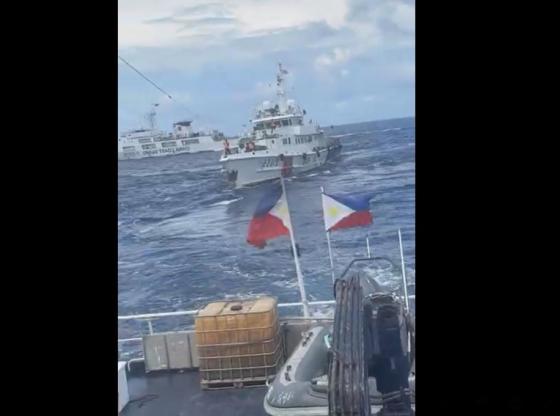

China Coast Guard (CCG) vessels rammed the BRP Datu Sanday, a vessel of the Bureau of Fisheries and Aquatic Resources (BFAR), and used water cannons on it near Escoda Shoal on Sunday.
During a live report by GMA Integrated News reporter Ian Cruz, two additional CCG ships were seen following the BRP Datu Sanday. The CCG vessels repeatedly rammed the Philippine ship before eventually maintaining a distance
Shortly afterward, another CCG vessel used water cannons on the BRP Datu Sanday. A Chinese militia vessel was also observed approaching. Cruz reported that the CCG vessel rammed the BRP Datu Sanday at least five times. Chinese ships had been surrounding the Datu Sanday since 10:30 a.m., with some aiming water cannons at the roof where its navigational equipment is located.
The BRP Datu Sanday was seen being water-cannoned as Cruz’s live report concluded.
GMA News Online sought comments from the Philippine Coast Guard (PCG), the Presidential Communications Office, and the National Maritime Council (NMC).
In a statement, the CCG claimed that the BRP Datu Sanday “illegally stormed” into what it considers Chinese territory and approached their vessels in a “dangerous manner.” The CCG stated that they took control measures “in accordance with law and regulations.”
China’s state broadcaster CCTV reported, “[b]ased on humanitarian principles, China immediately rescued the Philippine people who fell into the water. We warn the Philippine side to immediately stop the infringement; otherwise, the Philippine side will bear all the consequences arising therefrom.”
In contrast, the Philippine National Security Council (NSC) dismissed the CCG’s claims as “completely unfounded.”
“This fake news and misinformation serves as a clear illustration of the People’s Republic of China’s willingness to distort the truth and engage in disinformation to bolster its public image,” the NSC stated.
The NSC added, “The Philippine government calls on the People’s Republic of China to halt these provocative actions that destabilize regional peace and security. The Philippines remains steadfast in asserting its rights in accordance with the United Nations Convention on the Law of the Sea and the 2016 Arbitral Award.”
The BRP Datu Sanday was on a humanitarian mission from Hasa-Hasa Shoal to deliver diesel, food, and medical supplies to Filipino fishermen in Escoda Shoal, located 60 nautical miles from Palawan.
According to the NSC, the “aggressive and dangerous” maneuvers of eight Chinese vessels caused the BRP Datu Sanday’s engine to fail, forcing an early termination of the humanitarian operation. “These unprofessional, aggressive, and illegal actions posed serious risks to the safety of the Filipino crew and the fishermen they were meant to serve,” the NSC added. Fortunately, the crew aboard the BRP Datu Sanday remained safe.
Earlier this week, a CCG vessel collided with the PCG’s BRP Bagacay near Escoda Shoal. NPC spokesperson Alexander Lopez stated that the Philippine government is considering filing a case against China following the August 19 collision. PCG spokesperson on the West Philippine Sea, Commodore Jay Tarriela, described the collision as potentially the worst incident the PCG has faced.
Escoda Shoal, also known as Sabina Shoal, is within the Philippines’ 200-nautical-mile exclusive economic zone (EEZ) under the 1982 United Nations Convention on the Law of the Sea, located 75 nautical miles or about 140 kilometers off Palawan.
There have been multiple incidents involving Philippine vessels and Chinese ships in the West Philippine Sea, including a serious injury to a Philippine Navy service member during a regular rotation and resupply (RORE) mission at Ayungin Shoal in June.
On June 15, Beijing initiated a “no trespassing” policy, allowing the China Coast Guard to detain “foreign trespassers” in its claimed territories for up to 60 days without trial.
In 2013, the Philippines challenged China’s claims over the West Philippine Sea, winning a landmark ruling from an international tribunal in 2016 that invalidated Beijing’s claims. However, China has refused to recognize the ruling and continues to claim the area based on its “nine-dash line.”
The Philippines has already filed 153 diplomatic protests against China regarding the territorial dispute under the administration of President Ferdinand “Bongbong” Marcos Jr.