
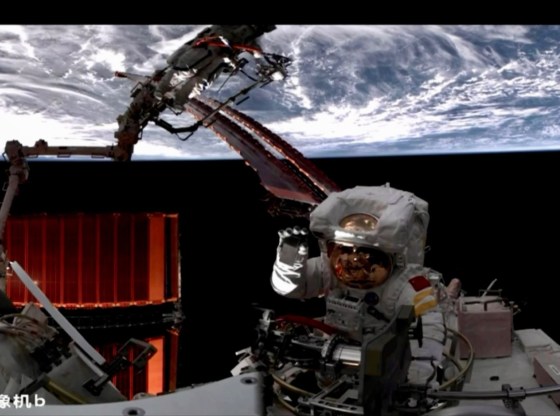

Two astronauts from China’s Tiangong space station conducted a spacewalk last week to fortify the station’s exterior against space debris caused by a recently exploded Russian satellite.
The spacewalk, aimed at enhancing the station’s long-term safety, involved installing protective devices on external cables and pipelines. “The spacewalk primarily focused on installing protective devices on external cables and pipelines to mitigate risks posed by potential space debris collisions,” said Liu Ming, an engineer from China Aerospace Science and Technology Corporation.
This precautionary measure follows the breakup of the retired Earth observation satellite Resurs-P1, which scattered over 100 pieces of debris now tracked by the US Space Command. The astronauts on the ISS had to take shelter due to this incident, highlighting the growing risk of space debris.
Astronaut Li Cong, assisted by a robotic arm and fellow crew member Ye Guangfu, installed the necessary equipment while Li Guangu monitored the mission. The 6.5-hour spacewalk was successful, with the astronauts even sharing light-hearted moments and poses for the camera.
“Whenever the robotic arm sent me to high points, despite the glaring sunlight, I [could not] help but want to take a closer look,” Li Cong shared. “It’s truly moving to witness the grandeur of this project.”
Since their arrival on April 26, the crew has installed several protective devices on the Tiangong space station, including on the Mengtian lab module during a previous spacewalk. The latest mission focused on the Wentian lab and Tianhe core module.
Similar to the ISS, which uses ballistic panels to protect against micrometeoroids and orbital debris, Tiangong’s enhancements are crucial. As space becomes increasingly cluttered with debris, space agencies must develop innovative solutions to ensure crew safety and mission integrity.