
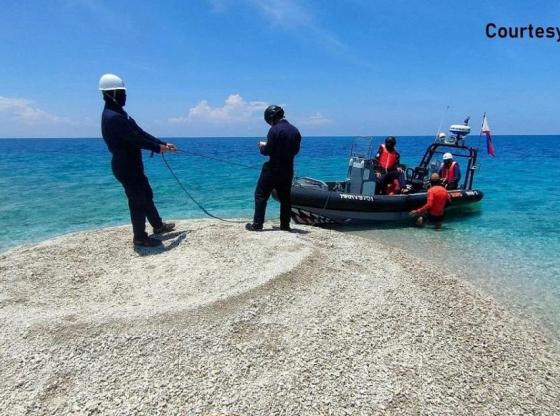

University of the Philippines Institute of Biology marine scientist, Dr. Jonathan Anticamara, has suggested that natural processes could be responsible for the piles of crushed coral found near Escoda (Sabina) Shoal in the West Philippine Sea.
At the sidelines of the Saturday News Forum in Quezon City, Dr. Anticamara responded to questions regarding possible reclamation activities at Escoda Shoal, as claimed by the Philippine Coast Guard (PCG). The PCG alleged that crushed corals were dumped in preparation for China’s island-building efforts.
“Right now we’re not sure… [but] we know that there is a growing pile of rubble that’s been observed in recent years,” Anticamara said. “But since we didn’t see China dumping it… We’re not 100% sure if there is dumping or reclamation.”
Anticamara explained that the pile of dead corals could have naturally accumulated due to tropical cyclones that frequently hit the area.
Recent Chinese Activities
According to a “24 Oras Weekend” report by Darlene Cay, Anticamara noted that recent Chinese dives at Escoda Shoal might have been attempts to study the corals in the area.
“Hindi naman ‘yun gawa nung mga PCG. Wala naman silang gagawin na ganun. Alam din natin na just recently, nag-dive ang mga Chinese all around Escoda. So, we can sort of infer na gawa nila ‘yun,” Anticamara said.
Philippine authorities are set to conduct further investigations into these activities.
“If China continues to block all our activities, research, conservation management… tuluyang mamamatay ang ecosystems na ito,” Anticamara warned.
Controversy Over Reclamation Claims
Last month, the PCG accused China of building an artificial island at Escoda Shoal. PCG spokesperson Commodore Jay Tarriela said that dead and crushed coral were dumped on the sandbars of Escoda Shoal, altering their size and elevation. Chinese Foreign Ministry spokesperson Wang Wenbin dismissed these allegations as “rumor.”
Despite the uncertainty over the origins of the crushed coral, Anticamara emphasized the need for vigilance. “We need to pay attention.”
Maritime law expert Atty. Jay Batongbacal added, “We should be careful with our evidence and distinguish between what is natural and what is artificial.”
Anticamara reiterated that nearly 100% of the corals in Escoda Shoal are dead, primarily due to extensive coral bleaching, but he said there isn’t enough evidence to directly link this to China’s actions in the area.
Diplomatic and Environmental Concerns
China’s People’s Liberation Army (PLA) recently held military exercises at Escoda Shoal, which the Philippine Navy criticized. Batongbacal suggested these issues be raised with the United Nations General Assembly and the United Nations Security Council, despite China’s veto power.
“Of course, we know that since China has veto power in the UN Security Council, it probably wouldn’t move forward. But the mere fact that we would bring this up to the international community so they can find out what is happening and what the truth is—that’s already an important step,” he said.
Environmental Preservation
Anticamara emphasized the need for concrete actions to restore degraded coral reefs in the Philippines. Escoda Shoal is a crucial rendezvous point for vessels resupplying Filipino troops stationed on the BRP Sierra Madre at Ayungin Shoal.
China’s extensive territorial claims over the South China Sea overlap with those of the Philippines, Vietnam, Malaysia, and Brunei. In 2016, an international arbitration tribunal in The Hague ruled that China’s claims had no legal basis, a decision Beijing does not recognize.