
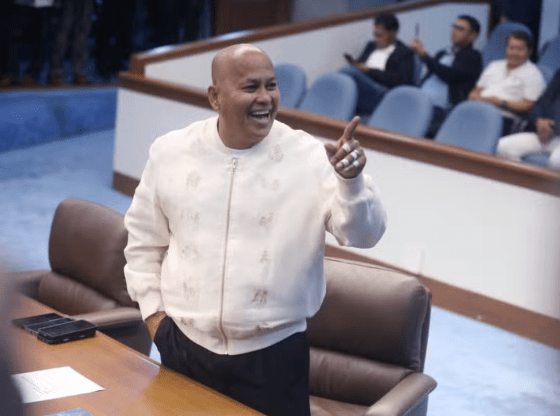


MANILA, Philippines — The Department of the Interior and Local Government (DILG) has formally defended its decision to hold off on executing international legal orders, citing explicit directives from Malacañang. The DILG clarified that its decision not to immediately enforce the International Criminal Court (ICC) warrant against Senator Ronald “Bato” dela Rosa stems directly from a presidential mandate to prioritize domestic judicial supremacy.
In an official statement, the department emphasized that its actions “were never rooted in an unwillingness to enforce the law,” but rather in a commitment to legal and constitutional protocol.
The DILG revealed that the primary catalyst for the operational pause is an active administrative directive issued by President Ferdinand Marcos Jr. to all executive and law enforcement branches, including the DILG and the Philippine National Police (PNP):
- The Presidential Mandate: Law enforcement agencies have been explicitly ordered to await a definitive resolution from the Supreme Court of the Philippines regarding the domestic enforceability of the ICC warrant.
- The Local Warrant Prerequisite: Under this Malacañang framework, the executive branch maintains that an international warrant cannot be served on an incumbent senator absent a corresponding, complementary order issued by a domestic Philippine court.
The DILG’s clarification comes amid intense finger-pointing following a chaotic operational breakdown at the legislative building.
The timeline of events highlights a severe lack of coordination among law enforcement agencies:
[Nov 6, 2025: ICC Warrant Issued Confidential] ──► [May 11, 2026: NBI Attempts Arrest at Senate] ──► [Dela Rosa Flees Plenary] ──► [Senate Grants Protective Custody]
- The Surprise Return: After a six-month absence from public view to evade rumored international arrest orders, Dela Rosa unexpectedly returned to the Senate floor on Monday, May 11, 2026, to cast a decisive vote in a sudden leadership coup that installed Alan Peter Cayetano as Senate President.
- The Foiled NBI Operation: While the DILG and the PNP stood down under the President’s orders, the National Bureau of Investigation (NBI)—which operates under the Department of Justice (DOJ)—independently attempted to enforce the ICC warrant inside the Senate premises.
- The Plenary Escape: Spotting the arriving NBI agents, Dela Rosa physically ran through the Senate halls to evade capture. The plenary immediately shifted into an emergency session, passing a motion to place Dela Rosa under the Senate’s formal “protective custody.”
- The DILG Pushback: Following the incident, former Senator Antonio Trillanes IV fiercely criticized DILG Secretary Jonvic Remulla for failing to arrest the senator. Remulla quickly pushed back, clarifying that the NBI acts independently of his department and reiterating that any premature enforcement by the PNP would violate the President’s explicit jurisdictional directives.
The standoff has triggered a massive constitutional debate among the country’s top legal minds regarding how international human rights warrants interface with domestic legislation:
- The Administration & Defense Argument: Vice President Sara Duterte and Dela Rosa’s legal panel argue that because the Philippines officially withdrew from the Rome Statute in 2019, the ICC has zero jurisdiction over Filipino citizens. They assert that enforcing a foreign warrant without local judicial vetting represents a direct violation of Philippine sovereignty.
- The Statutory Counter-Argument: Opposing legal experts, including Rep. Leila de Lima, flatly reject this stance. De Lima points directly to Republic Act No. 9851 (the Philippine Act on Crimes Against International Humanitarian Law, Genocide, and Other Crimes Against Humanity). Under this unrepealed domestic law, Philippine authorities are explicitly authorized to cooperate and surrender individuals to international tribunals investigating crimes against humanity, meaning a local warrant is legally redundant.
- No Parliamentary Immunity: Legal analysts also note that parliamentary immunity does not apply in this scenario. The 1987 Constitution only protects lawmakers from arrest while Congress is in session if the punishable offense carries a penalty of less than six years. Because crimes against humanity carry a baseline penalty of reclusion perpetua (up to 40 years), Dela Rosa enjoys no automatic legislative shield from the charges.
As the Supreme Court en banc reviews an urgent petition filed by Dela Rosa seeking a temporary restraining order (TRO) against his potential detention, the Department of Justice has adjusted its field directives.
The DOJ has officially instructed the PNP, the Bureau of Immigration, and peripheral border patrol networks to leave the senator undisturbed within domestic borders for now. However, law enforcement retains strict instructions to immediately arrest Dela Rosa if he makes any physical attempt to leave the territory of the Philippines.