
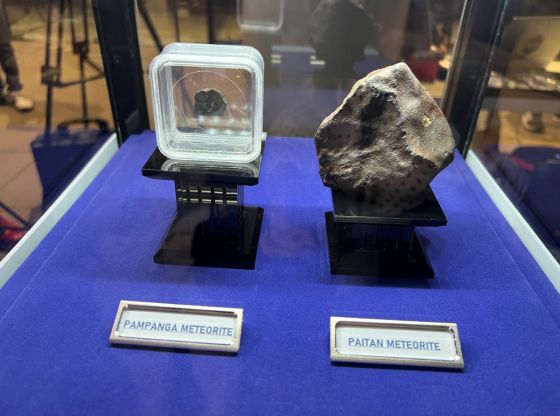

The Pampanga and Paitan meteorites have finally returned home to the Philippines after decades abroad.
At a special unveiling event in a Pasig City mall, the Philippine Meteorite Repatriation Team, in partnership with the Manila Street Astronomers and the Philippine Astronomical Society, showcased these rare celestial fragments to the public.
Decades-Long Search for Lost Philippine Meteorites
Meteorite collector Allan Yu, who has been collecting space rocks for nearly 20 years, admitted he once thought the country’s meteorites were lost to history.
“I never thought we could complete the Filipino meteorites,” Yu shared. “But with new energy and dedication, we were able to find and recover them.”
The team spent years tracking down these historic space rocks, which were scattered across international museums and private collections.
The Stories Behind the Meteorites
🌠 The Pampanga Meteorite (1859)
The Pampanga meteorite, the oldest documented meteorite in the Philippines, fell in Mexico, Pampanga in 1859. Described as a flaming rock that crashed behind Santa Monica Church, it reportedly emitted a gunpowder-like smell, prompting the Gobernador-General to send it abroad for study.
☄️ The Paitan Meteorite (1910)
The Paitan meteorite, which fell in Ilocos Sur in 1910, makes up 80-90% of its original mass. Some experts believe it originated from Halley’s Comet, which passed over Earth the same year. At the time, locals feared it was a sign of the world’s end, leading its discoverer to hide it for 75 years before it was finally tested and confirmed as a meteorite.
A Future for Philippine Space Science
Dr. Jeff Aguilar, one of the lead researchers, emphasized the importance of these meteorites for scientific study and future generations.
“We need to bring back all our meteorites so that younger generations can study them. That’s why we’re working on repatriating all seven known Philippine meteorites.”
The final missing meteorite, the Calivo meteorite from the 1900s, is currently being traced.
Hands-On Experience for Visitors
Attendees had a rare opportunity to touch fragments of the asteroid Vesta—the second-largest asteroid in our solar system—as well as a moon rock.
Other fascinating exhibits included:
🔭 A vial of liquid mimicking Jupiter’s scent, based on NASA data
🌕 Moon rocks and planetary samples
🪨 Meteorite-impacted artifacts
📜 Historical documents on the Pampanga meteorite’s fall
The highlight of the exhibit was a large fragment of the Bondoc meteorite, which landed in Quezon Province 2.5 million years ago, making it the oldest meteorite found in the Philippines.
What’s Next?
The team plans to donate specimens to the National Museum for public viewing, ensuring that these cosmic relics remain accessible for education and research.
“Our mission is to search, collect, and most importantly, share,” said geoscientist Mar Christian Cruz. “Seeing an actual specimen is so much more powerful than just reading about it in a book.”