
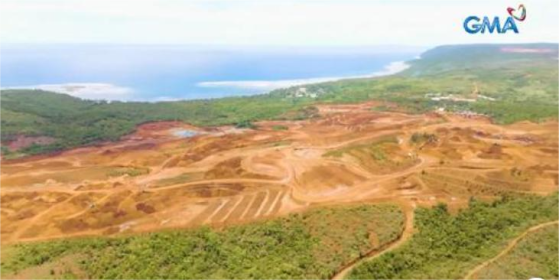

Residents of Homonhon Island in Eastern Samar are increasingly worried about the extensive and growing mining activities on their island, fearing the destruction of their once pristine environment. This issue was highlighted in a recent episode of “Kapuso Mo, Jessica Soho,” where the local community expressed their anxieties about the adverse effects of mining on their land and livelihood.
Homonhon, not only rich in natural beauty but also in valuable minerals like nickel and chromite, has seen a surge in mining since the first “small scale” mining permit was issued in 1983. The situation escalated in 2009 when a company was officially permitted to mine, leading to up to five companies eventually operating on the island. These operations have not only transformed vast areas into open pits but also led to increased pollution, affecting the local ecosystem and the health of the community.
The residents have reported significant environmental damage, including their waters turning into seas of mud and their crops, particularly calamansi—which is considered as valuable as gold locally—being coated in dust. The presence of heavy machinery carving out paths to extract underground minerals further exacerbates the situation, causing concern among the local populace.
Jonito Caberio, a council member from Barangay Bitaugan, stated that mining operations have even encroached on their barangay without proper endorsements from local authorities. A resolution has been submitted to the Department of Environment and Natural Resources (DENR) opposing the mining, but the community feels their concerns are being overlooked. Local efforts are supported by the church and various NGOs, which are rallying against the continuation and expansion of mining activities.
Amid these community protests, the Mines and Geosciences Bureau (MGB) reports that mining has brought significant financial contributions to both local and national governments. In contrast, Guiuan Mayor Annaliza Kwan has voiced opposition to mining in Barangay Bitaugan, emphasizing a shift towards agricultural and agro-industrial development to preserve the area’s natural resources and community welfare.
Despite the backlash, some mining companies insist on the legality and benefits of their operations. Digna Evangelista, an operator from Nickelace Inc., expressed that they view the opposition as a chance to develop strategies to demonstrate that their intentions are to develop the area responsibly.
As tensions between economic interests and environmental preservation escalate, the future of Homonhon Island hangs in the balance. The community continues to fight for the protection of their home, hoping for a sustainable solution that respects both the environment and their quality of life.