


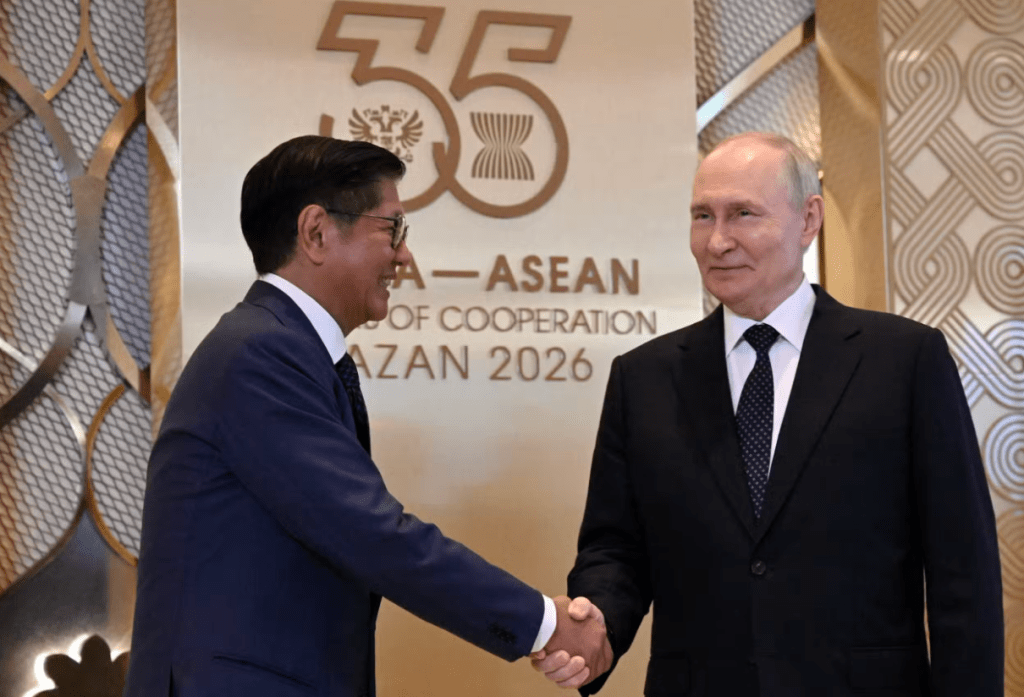
MANILA, Philippines — In a historic diplomatic overture on the global stage, President Ferdinand Marcos Jr. has extended an official invitation to Russian President Vladimir Putin to make his first-ever state visit to the Philippines. Marcos extended the invitation during a high-profile bilateral meeting with Putin in the southwestern city of Kazan, Russia.
The high-stakes invitation was extended on Thursday on the sidelines of the commemorative summit between the Association of Southeast Asian Nations (ASEAN) and Russia, with the Philippines serving as the current ASEAN chair.
Marcos explicitly invited the Russian leader to travel to Manila this coming November 2026 to personally participate in the 21st East Asia Summit (EAS).
The EAS is the premier regional forum for strategic dialogue and cooperation across the Indo-Pacific, pairing the 11-member ASEAN bloc with eight critical global dialogue partners:
                            [ THE 8 OUTSIDE DIALOGUE PARTNERS ]
                                             │
         ┌───────────────────────────────────┼───────────────────────────────────┐
         ▼                                   ▼                                   ▼
   [ UNALIGNED POWERS ]                [ WESTERN ALLIES ]                  [ REGIONAL GIANTS ]
 • **Russia**                        • **United States**                 • **China**
 • **India**                         • **Australia**                     • **Japan**
 •                                   • **New Zealand**                   • **South Korea**
While former President Rodrigo Duterte repeatedly extended open-ended invitations to Putin during his term—frequently calling the Russian leader his “idol”—Putin has yet to step foot in the Philippines. To date, Putin has only physically attended the East Asia Summit once, during the 2018 iteration held in Singapore.
While neither Malacañang nor the Kremlin released an official statement regarding a definitive acceptance, reporters on the ground noted that the Russian leader was seen nodding his head in acknowledgment during the exchange.
The bilateral meeting holds intense historical weight, occurring exactly as Manila and Moscow celebrate the 50th anniversary of diplomatic relations, which were originally established on June 2, 1976, during a state visit to the Soviet Union by the President’s late father, Ferdinand Marcos Sr.
[ THE EXPANDING ECONOMIC SECTORS ] │ ▼[ $500-Million Base ] ──► Bilateral trade between the Philippines and Russia exceeded **$500 million last year**, with both leaders agreeing that the current metric represents a fraction of its true potential. │ ▼[ Agricultural Push ] ──► Putin expressed an immediate interest in expanding the supply of Russian grain and fertilizer inputs to boost local Philippine crop cultivation yields. │ ▼[ Energy Lifeline ] ──► Following severe disruptions to global oil supplies, Manila safely acquired crude oil from Russia under a targeted US waiver protocol, opening the door for future nuclear energy consultations.
While the invitation represents standard multilateral protocol for an ASEAN host country, it places Manila directly underneath a fierce international spotlight. Putin remains subject to an active International Criminal Court (ICC) arrest warrant issued in March 2023 over the unlawful transfer of Ukrainian children.
The Geopolitical Reality: Under the Rome Statute, member nations are technically obligated to execute active ICC arrest warrants. However, because the Philippines formally withdrew from the ICC during the Duterte administration, Manila holds significant legal autonomy regarding how it navigates international court mandates, turning a potentially rigid judicial arrest obligation into a highly delicate sovereign calculation.
With the Philippines aiming to preserve its vital maritime defense treaties with the United States and Western allies while simultaneously maintaining an independent “friend to all, enemy to none” foreign policy posture, Putin’s potential arrival in Manila this November will serve as the ultimate test of the administration’s strategic diplomacy.