
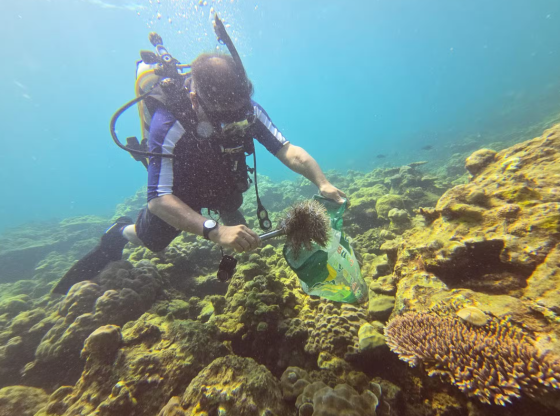


SAN ANTONIO, Zambales — As part of the annual Month of the Ocean celebration, government and local divers conducted an underwater conservation mission on Tuesday, May 12, 2026, to protect a vital marine sanctuary in Masinloc, Zambales. The activity targeted the four-hectare Taklobo (Giant Clam) Farm, a strictly protected zone within the Masinloc and Oyon Bay Protected Landscape and Seascape (MOBPLS).
The mission focused on the manual removal of biological and man-made hazards that threaten the health of the coral reef ecosystem:
- Crown-of-Thorns Starfish (COTS): Divers collected 17 of these coral-eating starfish. Left unchecked, a COTS outbreak can devastate entire reef colonies by preying on living coral tissue.
- Abandoned Fishing Gear: The team recovered a long fishing line with hooks that had been left inside the protected area. Known as “ghost gear,” these materials continue to trap marine life and damage coral structures long after being discarded.
The collaborative effort involved personnel from multiple environmental and local government units:
- CENRO-Masinloc (Community Environment and Natural Resources Office)
- PENRO-Zambales (Provincial Environment and Natural Resources Office)
- MENRO-Masinloc (Municipal Environment and Natural Resources Office)
- Local tourism authorities and stakeholders.
The activity served as a reminder of the strict protections provided under Republic Act No. 11038, or the Expanded National Integrated Protected Areas System (ENIPAS) Act of 2018.
- Prohibited Acts: Unauthorized fishing, possession of fishing gear, and dumping of waste are strictly forbidden within these marine protected areas.
- Strict Protection Zones: The Taklobo Farm is classified as a zone where human activity is heavily restricted to ensure the undisturbed recovery and growth of marine biodiversity.
- Community Stewardship: Officials emphasized that such dives aim to inspire coastal communities to become active stewards of their local seas.
The Philippines celebrates Month of the Ocean every May (per Presidential Proclamation No. 57, s. 1999) to highlight the ecological and economic importance of the country’s coastal and marine resources.
The 2026 observance comes at a critical time, as the Philippines—located within the Coral Triangle—faces increasing pressure from rising sea temperatures and the localized impacts of a record-breaking El Niño forecast for the latter half of the year.