
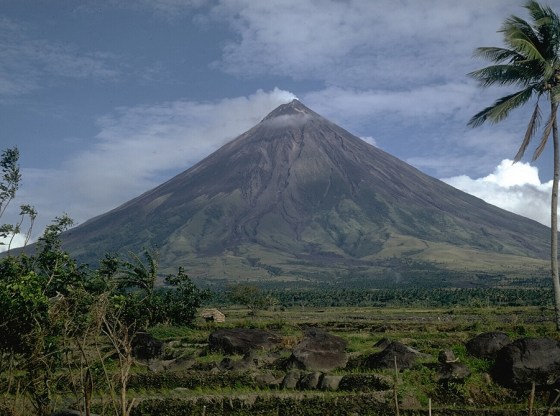

By: Raydes B. Barcia
Legazpi City —The country’s most active Mayon Volcano is restive again four years after the recent recorded eruption.
The Philippine Institute of volcanology and Seismology (Phivolcs) hoisted the alert level one status of Mount Mayon following restive condition.
Alanis said that since 2018 the faint crater glow is continuously exhibited due to remnants of magma.
When asked if there is a possible fresh magma build-up beneath the volcano, Alanis said that there is no presence of fresh magma build-up but solely the old magma stationary within the belly of the volcano.
“We do not see any indication that there is a new magma at this time. It’s likely degassing. Large amounts of gasses pushing the leftover magma out,” he said.
“There is also a presence of a dome, from the 2018 eruption. The faint crater has been growing continuously since 2018 using cameras,” he added.
The Mayon Volcano’s unrest threatens anew the recovery of Albay following the impact of three consecutive stronger typhoons that hit in the province during the hardest pandemic lockdown.
Thus, the restiveness of the volcano is in time of the rainy and typhoon seasons in the region specifically in Albay, the one-stop-shop of all types of natural calamities.
Since the Alert Level status of Mayon Volcano was lowered from Alert Level 1 to Alert Level 0 last 30 July 2021, monitored parameters have been generally unremarkable, Phivolcs said.
Today, August 21, 2022, the Philippine Institute of Volcanology and Seismology (Phivolcs) hoisted the alert level one status of Mayon Volcano from Alert Level 0 (Normal) to Alert Level 1(Low-Level Unrest).
Ground deformation observations from Global Positioning Systems (GPS), precise leveling (PL), electronic tilt, and electronic distance meter (EDM) monitoring have tracked slight short-term inflation of the volcano edifice, particularly on the northwestern and southeastern slopes, since April 2022, Phivolcs bulletin said.
However, daily visual and camera monitoring of the summit crater revealed that the remnant lava dome emplaced towards the end of the 2018 eruption has undergone a change in morphology and slight extrusion of approximately 40,000 m3 between June 6 and August 20, 2022. In contrast, the latest measured SO2 emission on August 12, 2022, averaged 688 tonnes per day, near baseline levels.
Short-lived spikes in the number of low-frequency volcanic earthquakes were recorded on May 26, and June 20, 2022, but for most of this year, only baseline seismic activity has been detected.
These observation parameters indicate that volcanic gas-induced pressurization at the shallow depths of the edifice may be occurring, causing the summit dome of Mayon to be pushed out. This means that the volcano is exhibiting abnormal conditions and has entered a period of unrest.
The public is reminded that entry into the 6-km Permanent Danger Zone or PDZ must be strictly avoided due to an increase in the chances of sudden steam-driven or phreatic eruption, as well as the perennial hazards of the rockfalls, avalanches, and ash bursts at the summit area, that may occur without warning.
Phivolcs warned the people living in valleys and active river channels to remain vigilant against sediment-laden stream flows and lahars in the event of prolonged and heavy rainfall brought about by the advent of the rainy season. PHIVOLCS-DOST is closely monitoring Mayon Volcano’s activity and any new development will be immediately communicate to all concerned, the Phivolcs said.