
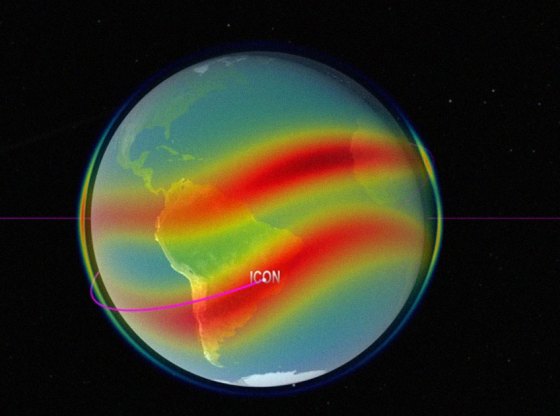

NASA scientists have detected unusual spectral formations in the Earth’s ionosphere, located hundreds of miles above the surface. These findings could provide new insights into how space weather impacts our upper atmosphere.
Unveiling the Mystery
The ionosphere, which extends from 50 to 400 miles above Earth, forms the boundary between our atmosphere and outer space. It’s a critical region housing most of our satellites but is susceptible to changes in space weather, such as electromagnetic radiation from the Sun, which can disrupt communications.
Using the Global-scale Observations of the Limb and Disk (GOLD) imaging instrument, NASA has observed plasma bands creating bizarre X and C shapes within the ionosphere. This “alphabet soup” of formations is puzzling scientists, as it appears to occur even during geomagnetic quiet conditions, unlike previous observations linked to solar storms or volcanic eruptions.
Investigating the Unusual Shapes
Typically, charged particles in the ionosphere create dense bands or “crests” around the magnetic equator. Low-density pockets known as “bubbles” can also form due to the setting Sun. However, the recent discovery of X shapes during quiet conditions suggests other, more localized factors at play.
“The X is odd because it implies that there are far more localized driving factors,” said NASA scientist Jeffrey Klenzing. “Seeing it during quiet time suggests that the lower atmosphere activity is significantly driving the ionospheric structure.”
The Complexity of the Ionosphere
Scientists have also noted that some ionospheric bubbles can curve into C shapes, which sometimes appear close together. This complexity indicates that the dynamics of the ionosphere are more intricate than previously thought.
“The fact that we have very different shapes of bubbles this close together tells us that the dynamics of the atmosphere is more complex than we expected,” Klenzing added.
As research continues, these discoveries may enhance our understanding of the ionosphere and its effects on communication systems on Earth