
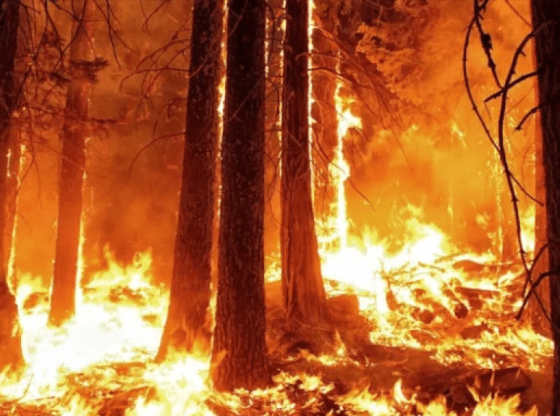

With the increasing frequency of severe forest fires worldwide, the need for advanced response strategies has become crucial. These fires devastate homes, destroy forests, and release significant amounts of greenhouse gases. Fortunately, NASA’s new wildfire AI aims to aid nations in combating these destructive blazes.
Dubbed the “Wildfire Digital Twin,” this innovative AI leverages past data to predict the likelihood of wildfires in specific areas. It also enhances communication between drones and ground crews without requiring internet access, ensuring firefighters receive the critical information they need promptly.
How Does the NASA Wildfire AI Work?
According to NASA, the Wildfire Digital Twin employs artificial intelligence and machine learning to forecast potential burn paths in real time. By analyzing historical wildfire data, it identifies areas at high risk for future fires.
Current global models can map smoke and fire spread with a resolution of 10 kilometers per pixel, generating simulations within hours. In contrast, NASA’s AI achieves a resolution of 10 to 30 meters per pixel in just minutes, offering a much more detailed and rapid response tool.
This system also addresses visibility issues that drone operators face due to smoke. It enhances coordination among crewed aircraft, drone operators, and ground crews, functioning seamlessly without online connectivity. Additionally, it is optimized for mobile devices and laptops, making it accessible in remote areas where internet is unavailable.
Milton Halem, a professor of Computer Science and Electrical Engineering at the University of Maryland, emphasized the importance of providing timely information to firefighters, even in areas lacking internet and supercomputers. “With our API version of the model, they could run the digital twin not just on a laptop, but even a tablet,” Halem explained.
Currently, the NASA wildfire AI is undergoing testing in several states, including Florida, Georgia, Mississippi, Tennessee, and South Carolina, to ensure its effectiveness in real-life scenarios.
As NASA Ames researcher Kathryn Chapman noted, “As fires continue to get bigger and more intense, we’re giving people the tools that allow them to also scale their response.”