
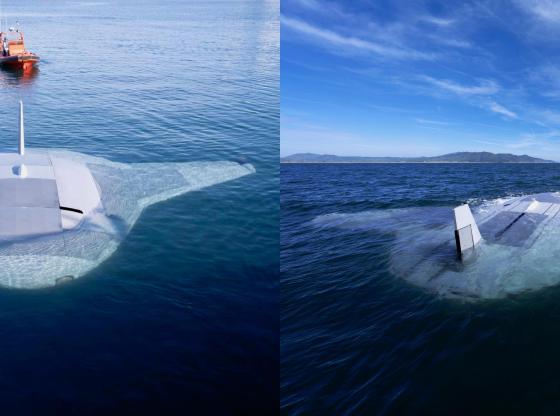

Northrop Grumman, a leading defense contractor, has revealed its latest technological marvel: a sophisticated military drone submarine named the Manta Ray. This uncrewed underwater vehicle (UUV) promises to revolutionize undersea warfare and reconnaissance missions, much like its oceanic namesake, the manta ray, glides effortlessly through the water.
A New Underwater Menace
The Manta Ray, developed under a 2020 contract with the Defense Advanced Research Projects Agency (DARPA), boasts a sleek and low-profile design. This cutting-edge underwater glider can autonomously navigate enemy waters, anchor itself on the sea floor to hibernate, and re-engage when needed. Its potential roles range from reconnaissance to combat, though the exact nature of its missions remains shrouded in secrecy.
Versatile and Autonomous
Northrop Grumman describes the Manta Ray as an “extra-large glider” designed for “long-duration, long-range, and payload-capable undersea missions without the need for on-site human logistics.” This broad description suggests a multitude of possible uses, from environmental monitoring to strategic military operations.
DARPA highlights the Manta Ray’s ability to enhance the capacity of combatant commanders without relying on manned vessels and ports, emphasizing its potential role in subsea warfare. According to Northrop Grumman’s VP of Strategy and Mission Solutions, Alan Lytle, the Manta Ray is a critical component of the Department of Defense’s Joint All-Domain Command and Control vision, offering payload capabilities from the sea.
Potential Applications
While specific details remain classified, the Manta Ray could be equipped for various tasks, including:
- Undersea Mapping: Utilizing advanced sonar and imaging technologies.
- Mine Detection: Identifying and neutralizing underwater mines.
- Passive Surveillance: Gathering intelligence while remaining undetected.
- Hazard Detection: Identifying and classifying underwater threats.
Speculations also hint at the possibility of weapon payloads, such as missile launchers or radio jammers, to disrupt enemy detection systems.
Future Deployment
The timeline for the Manta Ray’s deployment is uncertain. Given the sensitive nature of its missions, details on its operational use might remain undisclosed for some time. However, its development underscores the growing importance of autonomous systems in modern warfare and strategic defense.
As the military-industrial complex continues to innovate, the Manta Ray represents a significant leap forward in underwater technology, promising to enhance the capabilities of naval forces and redefine undersea operations.