
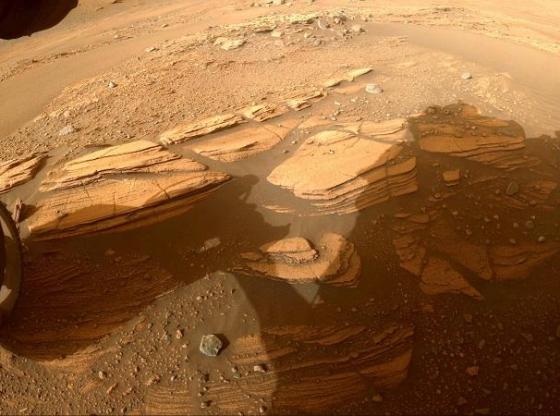

NASA’s Perseverance rover has unveiled groundbreaking evidence confirming the presence of ancient lake sediments in the Jezero Crater on Mars, marking a significant stride in space exploration and research. This discovery, stemming from detailed ground-penetrating radar observations by the rover, substantiates longstanding theories based on prior orbital imagery and data, suggesting that parts of the Red Planet were once water-rich and potentially hospitable to microbial life.
The collaborative research, spearheaded by experts from the University of California at Los Angeles (UCLA) and the University of Oslo, has been prominently featured in the journal Science Advances. The findings emerged from subsurface scans conducted by the car-sized, six-wheeled rover, which navigated the Martian terrain from the crater floor to an adjacent area marked by braided, sedimentary-like formations akin to Earth’s river deltas.
The rover’s RIMFAX radar instrument played a pivotal role, offering scientists a detailed cross-sectional view of the Martian subsurface, unveiling rock layers up to 65 feet deep. According to UCLA’s planetary scientist David Paige, this technique is comparable to examining a road cut, revealing soil sediments transported and deposited by water in the Jerezo Crater and its delta, much like the processes observed in Earth’s lakes.
These sedimentary layers, believed to have formed approximately 3 billion years ago, offer compelling proof of Mars’s wetter and potentially life-supporting past. Scientists eagerly anticipate further analysis of these ancient sediments, with samples currently being collected by Perseverance for eventual transport back to Earth.
While initial core samples drilled by Perseverance near its landing site in February 2021 puzzled researchers by indicating volcanic rather than sedimentary rock, the recent RIMFAX radar findings have clarified this picture. The radar data revealed a complex geological history, including evidence of erosion before and after the sedimentary layers were formed at the crater’s western edge.
The discovery of these ancient lake sediments, a primary objective for the mission, validates the choice of Jezero Crater as the landing site for the Perseverance rover and represents a promising chapter in our quest to understand the Martian environment and its potential for past life.