
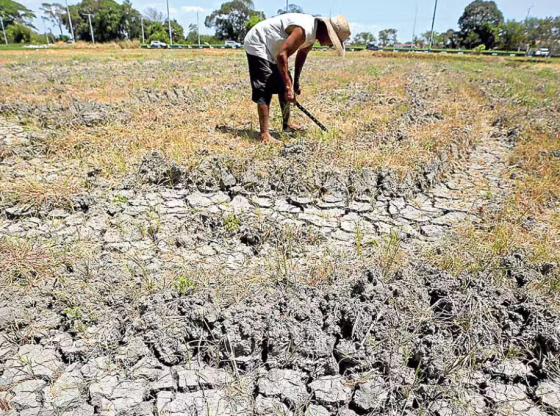


MANILA, Philippines — Bracing for a prolonged climate emergency, the Marcos administration is rapidly shifting its resource security protocols into a defensive posture. State weather models and regional climate projections indicate a high probability that a severe El Niño phenomenon will grip the country through the end of the year and persist deep into 2027.
The long-range environmental alert has triggered a comprehensive executive order directing multi-agency teams to insulate the national food, water, and energy grids from anticipated extreme drought.
The administration utilized a major infrastructure launch in the Visayas to signal its updated climate defense framework. Speaking on Monday, June 22, during the inauguration of the ₱833.37-million Mabini-Cayacay Small Reservoir Irrigation Project (SRIP) in Bohol, President Ferdinand Marcos Jr. went public with the sobering long-term projections:
                            [ THE MODELED EL NIÑO HORIZON ]
                                           │
         ┌─────────────────────────────────┴─────────────────────────────────┐
         ▼                                                                   ▼
   [ THE PAGASA METRIC ALERT ]                                         [ AGRICULTURAL ASSAULT RISK ]
 • **92% Probability Index:** State meteorologists at PAGASA confirm  • **700,000 MT Rice Threat:** The Department of Agriculture
   a 92% likelihood that a moderate-to-strong El Niño will lock in     • (DA) warns that an unmitigated dry run could instantly slash
   by the fourth quarter of 2026.                                     • national rice yields by up to 700,000 metric tons.
 • **Extended Timeline:** Data tracks sea surface anomalies keeping  • **The ₱57-Billion Shadow:** Planners are building defenses
   temperatures elevated well past historical seasonal brackets,      • to prevent a repeat of the brutal 2023–2024 episode, which
   extending the dry hazard into 2027.                                • inflicted **₱57.78 billion** in gross crop damage.
“According to our data, there is a high possibility that the country will experience severe El Niño that may last until next year, 2027,” the President stated, adding that the state is accelerating irrigation deployments precisely to buy local farmers a baseline structural cushion.
To counter catastrophic topsoil moisture loss, the National El Niño Team is ordering a massive pivot away from traditional, water-intensive agriculture across high-risk provinces during the dry cycles. Extension officers are actively distributing seed arrays for hardier, drought-resistant crops:
[ THE WATER-SAVING AGRARIAN BLUEPRINT ] │ ▼[ Approved Grains & Tubers ] ──► Watermelon, Ginger, Purple Yam (Ube), Peanuts, and Eggplant are being positioned as the primary substitute crops for farmers located outside major irrigation canals. │ ▼[ Increased Cycles ] ──► The newly unveiled Mabini-Cayacay SRIP—featuring a 32.2-meter dam—will serve as a model, using structured distribution to push local farmers from two cycles up to three cycles annually. │ ▼[ Primary Targets ] ──► Initial structural interventions will focus heavily on safeguarding **corn and rice lands**, which absorbed the absolute brunt of prior-year macroeconomic production declines.
Beyond the farm gates, Malacañang has reviewed a sweeping multi-sector action plan to prevent localized utility collapses as major reservoirs approach critical low-level status.
The emergency layout splits state operations across three primary civil lifelines:
| Sector Layer | Primary Executive Mandate | Lead Enforcement Agencies |
| Water Supply | Immediate desiltation of major reservoirs, structural facility repair, and enforcing strict urban conservation rules to prioritize domestic taps over commercial lines. | National Irrigation Administration (NIA) / Local Water Utilities |
| Energy Reliability | Securing fuel reserves, hardening critical grid transmission systems, and preventing plant outages to offset reduced hydroelectric capacities. | Department of Energy (DOE) / National Grid Corporation |
| Public Health | Setting up proactive medical queues to manage a projected spike in severe heat-related illnesses and waterborne pathogens. | Department of Health (DOH) / Local Barangay Health Units |
While PAGASA notes that the current southwest monsoon (Habagat) will continue to generate normal to above-normal rainfall across western Luzon through October 2026, the administration is treating this rainy window as a critical, final buffer period. Government units are ordered to utilize the remaining wet months to harvest excess runoffs, optimize water storage facilities, and complete major pipeline overhauls before the long-term heat lock settles over the archipelago.