
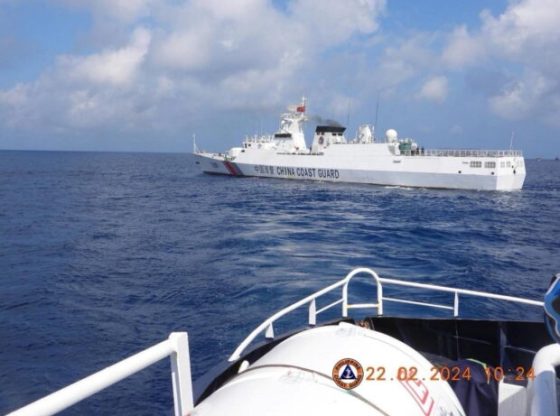

The Philippine Coast Guard (PCG) has raised concerns over the Chinese Coast Guard’s (CCG) alleged jamming of the tracking signals of Philippine ships during recent operations in the West Philippine Sea (WPS). According to PCG spokesperson for the West Philippine Sea, Commodore Jay Tarriela, this interference has intermittently prevented Philippine vessels from broadcasting their automatic identification signals (AIS), which are crucial for maritime safety and navigation.
The AIS system plays a vital role in maritime operations, allowing vessels to be identified and located by others at sea, as well as being trackable via ground stations and satellites. The alleged signal jamming incidents occurred amidst the rotational deployments of PCG and Bureau of Fisheries and Aquatic Resources (BFAR) ships at Bajo de Masinloc (Scarborough Shoal), with specific instances noted during the deployment of BFAR’s BRP Datu Sanday.
The PCG reported that on February 22, the CCG purportedly blocked the AIS of BRP Datu Sanday, coinciding with a CCG statement claiming the successful ‘repelling’ of the Philippine vessel from the area surrounding China’s Huangyan Dao. These actions have been interpreted as part of an information warfare strategy, with the CCG making public statements that the PCG views as unsupported by the facts on the ground.
This situation has further heightened tensions between China and the Philippines, who have been engaged in a long-standing dispute over sovereignty rights in the South China Sea. Bajo de Masinloc, within the Philippines’ exclusive economic zone (EEZ), has been a focal point of contention since China seized control of the shoal in 2012, despite a 2016 international arbitral tribunal ruling in favor of the Philippines.
The PCG has remained vigilant in its missions, despite facing challenges such as close encounters with Chinese ships and aerial surveillance by PLA-Navy helicopters. The commitment of the PCG and BFAR to secure the area and support Filipino fishermen underscores the ongoing territorial disputes in the South China Sea and the complex dynamics of regional security and sovereignty.