


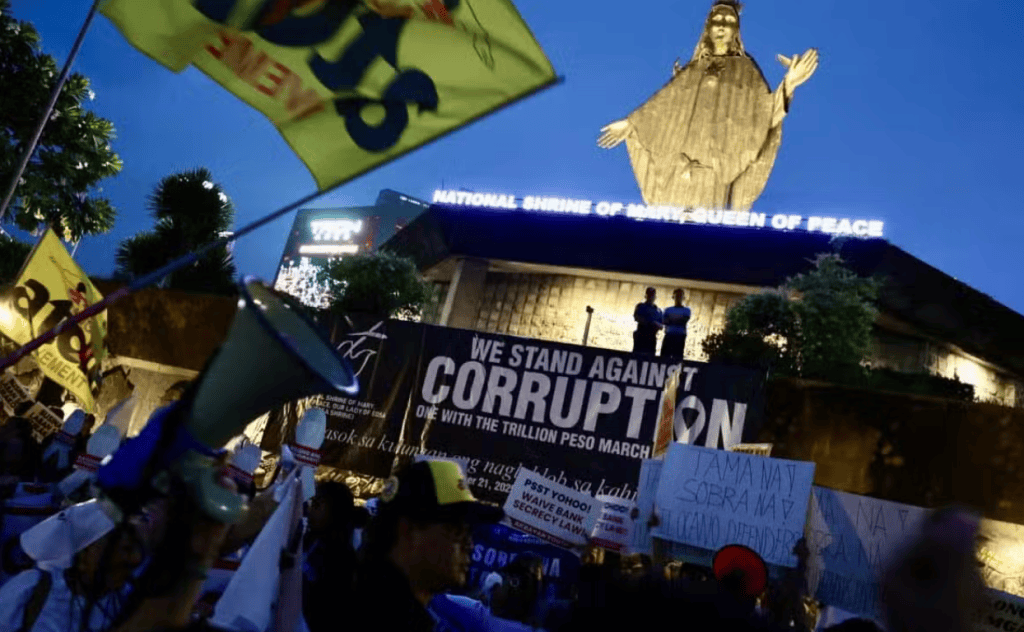
MANILA – As dawn broke over a city simmering with righteous anger, the Trillion Peso March erupted into a sea of white-clad demonstrators flooding the streets of Quezon City and Luneta Park on Sunday, November 30, 2025, in a thunderous rebuke of entrenched corruption that has drained billions from public coffers. What began as a coordinated cry against the P20-billion flood control fiasco – a labyrinth of ghost projects and kickbacks implicating lawmakers and contractors – swelled into a multisectoral roar, backed by 86 Catholic dioceses, labor unions, and fisherfolk collectives, transforming Edsa’s hallowed ground into a pulpit for the aggrieved and a pressure cooker for the powerful.
The morning’s momentum built like a gathering monsoon: By 6 a.m., thousands had converged at the People Power Monument, their white attire – a symbol of purity urged by bishops nationwide – fluttering like flags of defiance under a crisp blue sky. Organizers from the Trillion Peso March Movement (TPMM), led by Bayan Secretary-General Mong Palatino, kicked off with a labor pledge rally, where jeepney drivers and factory workers hoisted placards reading “Expose the Criminals, Return the People’s Money, Jail the Corrupt!” Palatino, megaphone in hand, thundered to the swelling crowd: “This is not just a march; it’s a mandate. The Filipino people will no longer tolerate a government that drowns us in floods while swimming in stolen wealth!” His words ignited chants of “Bigas, hindi balas!” (Rice, not bullets!), a nod to the graft’s ripple into empty pantries.
Parallel pulses throbbed across the metropolis: At Rizal Park, the People’s Movement Against Corruption’s “Baha sa Luneta 2.0” – a sequel to September’s deluge of dissent – drew an estimated 20,000 by 9:30 a.m., spilling onto Roxas Boulevard for a Holy Mass concelebrated by Cardinal Pablo “Ambo” David and Bishop Elias Lumayog Ayuban Jr. The liturgy, laced with readings on stewardship and justice, transitioned seamlessly into a reflection circle where survivors of the drug war and flood victims shared raw testimonies. “My home was washed away, but the real flood is the corruption that left us defenseless,” wept one Bulacan mother, her story met with a unified “Kami ay magkakapatid!” (We are family!).
Police presence loomed large yet restrained: Over 15,000 officers from the Philippine National Police (PNP), including elite units, formed a human chain along Edsa, but reports of zero clashes painted a picture of disciplined determination. NCRPO Director Nicolas Torre III, addressing media at the monument, affirmed: “Maximum tolerance is our policy. We’re here to protect the right to peaceably assemble, not to provoke.” No incidents marred the early hours, though minor scuffles arose at Mendiola’s barbed-wire blockade – a shipping-container fortress that rerouted marchers toward Luneta, drawing jeers of “Bawal na ba ang protesta?” (Is protesting now forbidden?).
By noon, attendance estimates ballooned: TPMM pegged Quezon City at 50,000 strong, with satellite rallies in Cebu, Davao, and Iloilo adding 10,000 more nationwide. Symbolic acts amplified the message: Fisherfolk from typhoon-ravaged Samar unfurled a massive net emblazoned with “Hindi kami tutubuan ng scam!” (We won’t be scammed!), while urban poor groups staged an “empty plate vigil” at Luneta, plates clattering in rhythmic protest against hunger born of graft. Artists like Ben&Ben lent their voices, debuting an acoustic set of anthems reworked with lyrics like “Bayad utang, hindi scam” (Pay debts, not scams), drawing tears and fists aloft.
Government responses trickled in measured tones: Interior Secretary Jonvic Remulla, monitoring from DILG headquarters, reiterated support for peaceful expression while warning against “disruptive elements.” President Ferdinand Marcos Jr., via a Palace statement, acknowledged the “legitimate concerns” but pivoted to probes: “The administration is committed to transparency; let the investigations run their course.” Yet, whispers from Malacañang insiders hinted at unease, with the march’s scale – rivaling Edsa’s echoes – pressuring a faster graft reckoning.
As the sun dipped toward Simbang Gabi vespers, the atmosphere crackled with cathartic hope: Families picnicked on Edsa medians, children waved handmade parols reading “Walang corrupt sa Pasko” (No corruption at Christmas), and elders led rosaries blending faith with fury. Palatino, wrapping the Quezon City leg, vowed continuity: “This is just the beginning. From Edsa to every barangay, the trillion-peso tide will wash away the filth.” By evening, as crowds dispersed under a canopy of stars, the march had etched itself into the nation’s narrative – not as chaos, but as a clarion: In the Philippines’ perennial battle for purity, the people’s power flows unblocked, one resolute step at a time.