
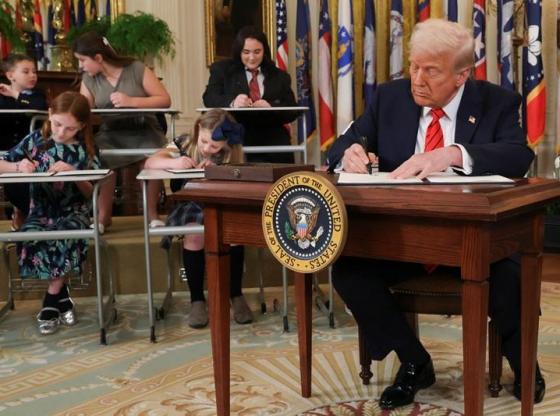

WASHINGTON, D.C. – President Donald Trump took a major step toward fulfilling a key conservative campaign promise on Thursday, signing an executive order aimed at significantly downsizing the U.S. Department of Education. Flanked by students and educators at the White House, Trump declared his intent to return control of education policy to states and local school boards.
“We’re going to be returning education, very simply, back to the states where it belongs,” Trump said during the signing ceremony in the East Room.
While completely shutting down the department requires congressional approval—an uphill battle given the need for Democratic votes—Trump’s order initiates efforts to strip the federal agency of many of its functions. His administration has already announced plans to cut nearly half of the department’s staff.
A Shift in Education Policy
The order would scale back the department to its core functions, such as managing student loans, Pell Grants, and resources for children with special needs. However, critics argue that dismantling the agency could disrupt federal funding programs, including aid for low-income schools and support for special education services.
Republican governors, including Greg Abbott of Texas and Ron DeSantis of Florida, stood alongside Trump at the event, while conservative advocacy group Moms for Liberty also received recognition for its role in pushing the agenda.
Despite Trump’s push, public opinion is largely against closing the department. A Reuters/Ipsos poll found that 65% of Americans oppose shutting it down, with only 30% in favor.
Legal Battles and Legislative Hurdles
Trump’s move is expected to face fierce opposition from Democrats and teachers’ unions. Randi Weingarten, president of the American Federation of Teachers, responded with a stark warning: “See you in court.”
Senator Patty Murray (D-Wash.) criticized the order, stating: “Donald Trump knows perfectly well he can’t abolish the Department of Education without Congress—but if you fire all the staff and smash it to pieces, you might get a similar, devastating result.”
Even within the Republican Party, past efforts to divert federal education funds to private and home schools have failed to gain traction. In 2023, a proposal to repurpose Title I funding for low-income schools was overwhelmingly rejected in the House of Representatives, with a majority of Republicans voting against it.
With Congress unlikely to fully eliminate the department, Trump hinted that the debate could ultimately lead to a legislative showdown.
The Bigger Picture
The Department of Education, established in the late 1970s, oversees funding for 100,000 public schools and 34,000 private institutions. It also administers $1.6 trillion in student loans, which millions of Americans rely on for college tuition.
The battle over education has been a major political flashpoint, particularly since the COVID-19 pandemic. Conservatives have increasingly pushed for school choice policies, while progressives continue to advocate for public school funding and federal oversight.
As Trump moves forward with his efforts to reshape the federal government, the future of the Department of Education remains uncertain—but the fight over its fate is just beginning.