


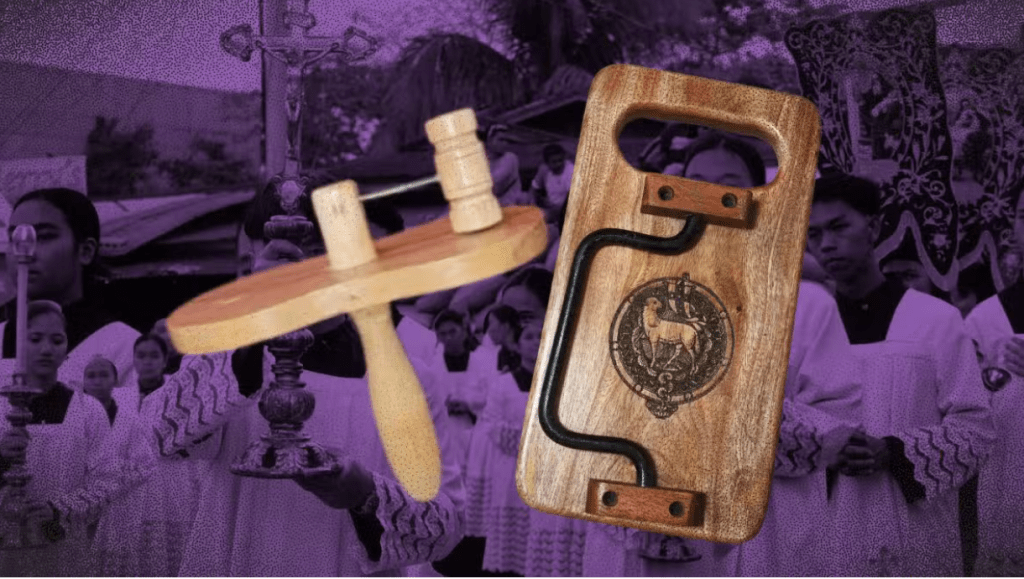
In the deep silence of the Triduum, a unique and ancient sound echoes through Philippine churches, marking one of the most somber transitions in the Catholic liturgical calendar.
As the “Gloria” is sung during the Mass of the Lord’s Supper on Holy Thursday, the ringing of church bells—usually a jubilant call to prayer—suddenly ceases. In their place, a dry, rhythmic wooden clatter known as the matraca takes over, signaling a period of deep mourning and reflection that lasts until the Easter Vigil.
The matraca is a traditional wooden ratchet or clapper that has been used for centuries in the Philippines and other Catholic nations. Its harsh, jarring sound is intended to replace the “joyful” ringing of bells, which are considered too celebratory for the commemoration of Christ’s Passion and death.
“The silence of the bells is a liturgical fast for our ears,” explained a church heritage advocate in Bulacan. “When you hear the matraca instead of the bells, it serves as a stark reminder that the Church is in a state of grief. It strips away the beauty of the music to focus on the gravity of the sacrifice.”
While many modern urban parishes have transitioned to electronic bell systems or simple silence, several provinces—most notably in Pampanga, Iloilo, and Cebu—are seeing a resurgence of the matraca.
Local artisans continue to craft these instruments from indigenous hardwoods, ensuring the mechanism produces a loud, snapping sound that can be heard across church plazas. In some older basilicas, massive wheel-shaped matracas are mounted in the belfries, requiring several altar servers to rotate them, creating a thunderous wooden drone that signifies the start of the “Great Silence.”
The use of wood instead of metal carries deep symbolic weight. It is often linked to the wood of the Cross, and the repetitive “clack-clack-clack” is said by some to mimic the sound of hammers driving nails into the hands and feet of Jesus.
For the faithful, the sound marks the beginning of the most intense period of the Lenten fast. “It changes the atmosphere of the town,” said a resident of a historic parish in Cavite. “When the bells stop, the world feels a bit heavier, a bit more serious. It forces you to listen to the silence.”
The retention of the matraca is part of a broader effort by the Philippine Church and cultural groups to preserve “Intangible Cultural Heritage.” By maintaining these sensory traditions, the Church provides a multi-sensory experience of faith that connects younger generations to the practices of their ancestors.
As the matracas fall silent on Holy Saturday and the bells “wake up” for the Easter Vigil, the transition from wood to metal becomes a powerful sonic metaphor for the Resurrection—from the heaviness of death to the ringing joy of new life.
Though the sound of the matraca may be jarring to some, for millions of Filipino Catholics, it is a comforting constant of the Lenten season. It is the sound of a community pausing together, setting aside the distractions of the modern world to walk the path of the Passion.
In a world filled with constant noise, the wooden clatter of the matraca remains a rare invitation to listen to what the silence has to say.