


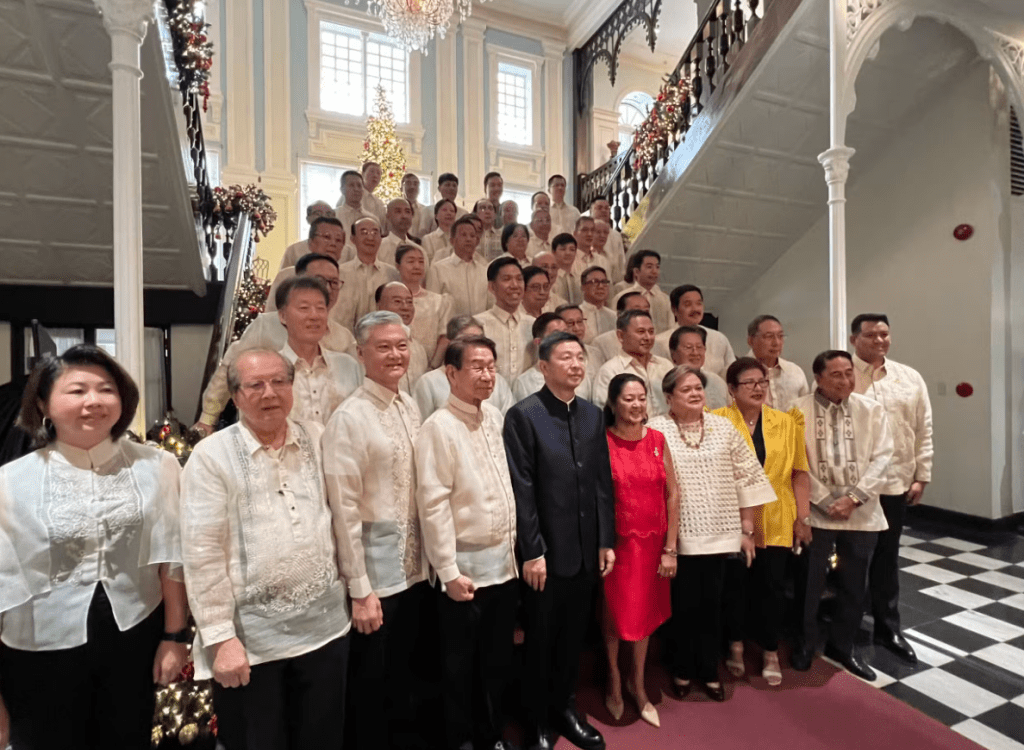
MANILA – Even as corruption scandals rock the political landscape and tensions simmer over the West Philippine Sea, the Federation of Filipino-Chinese Chambers of Commerce and Industry Inc. (FFCCCII), the nation’s largest umbrella group for Filipino-Chinese businesses, is doubling down on its commitment to local investments, viewing crises as springboards for opportunity rather than roadblocks. At the launch of a commemorative coffee-table book marking 50 years of diplomatic ties between the Philippines and China, FFCCCII leaders struck a defiant tone, insisting that “business as usual” will prevail despite the shaky ground beneath.
Cecilio Pedro, the FFCCCII’s honorary president, minced no words in his address at the Goldenberg Mansion near Malacañang Palace. “Where there is a crisis, there are always opportunities,” he declared, underscoring the Filipino-Chinese community’s resolve to keep pouring resources into job creation and economic advancement. “As local Chinese, we will continue to invest and pursue opportunities here,” Pedro added, framing the group’s ethos as one of steadfast partnership with the Philippines, no matter the headwinds.
The event, attended by a constellation of dignitaries including First Lady Liza Araneta-Marcos, Chinese Deputy Chief of Mission Zhou Zhiyong, Education Secretary Sonny Angara, and Foreign Affairs Secretary Teresita Daza Lazaro, doubled as a nod to the enduring economic bonds between the two nations. FFCCCII President Victor Lim echoed Pedro’s optimism, pledging to ramp up efforts in business partnerships and people-to-people exchanges. “We shall continue to expand our efforts to promote business partnership and people-to-people exchange between our two countries, and a deep understanding that will promote inclusive economic growth and social development,” Lim said, highlighting the chamber’s role in fostering ties that benefit both sides.
Yet, Lim was candid about the immediate pressures: Recent corruption controversies, including probes into multibillion-peso flood control projects, have cast a pall over business sentiment. “To be honest, after this kind of corruption problem, the business is a little bit slowing down,” he admitted, expressing hope that swift resolutions would reignite momentum. “We hope that these corruption issues will be addressed so that the country can grow faster.”
The backdrop adds layers to the chamber’s resilience. China, the Philippines’ top trading partner, supplied $3.41 billion in imports last October alone – 30.4% of the total – but its own economy is sputtering, with factory activity contracting for the eighth straight month in November. Pedro flagged this as a shared concern, stressing the need to nurture stable relations with both Beijing and Washington amid a global downturn. “We must stick to our relationship with our friends, specifically China and the US,” he urged, positioning the Philippines as a bridge in turbulent times.
For the FFCCCII, which represents over 200 chambers nationwide and champions Filipino-Chinese enterprises contributing billions to the economy, this reaffirmation feels like more than rhetoric – it’s a roadmap. In a year marked by domestic scandals and international frictions, the group’s “business as usual” mantra serves as a quiet rebellion, betting on opportunity’s spark to outshine crisis’s shadow.