
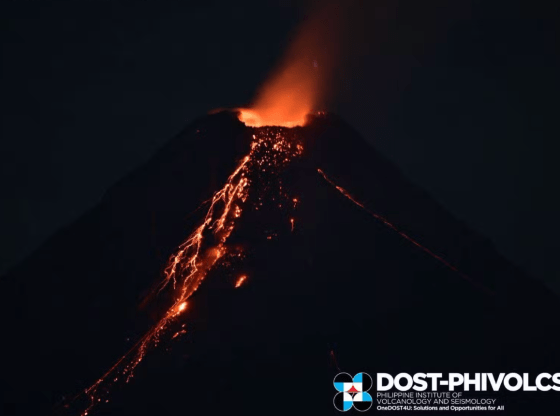

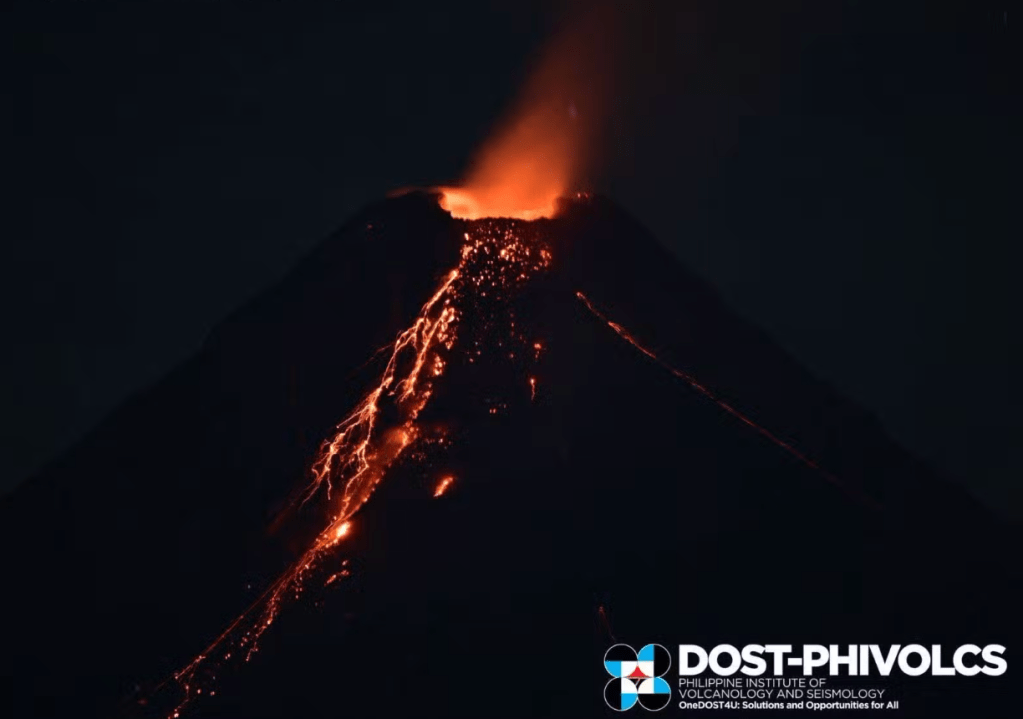
MANILA, Philippines — Extending its relentless cycle of magmatic activity into nearly half a year, one of the country’s most iconic and active natural landmarks continues to exhibit dangerous signs of strain. State volcanologists confirmed that Mayon Volcano in Albay has logged its 173rd consecutive day of effusive eruption, keeping a wide region under high alert.
The prolonged geological activity remains locked under Alert Level 3, meaning high-level magmatic unrest is ongoing and a hazardous explosive eruption is still entirely possible.
According to the Philippine Institute of Volcanology and Seismology (Phivolcs), Mayon’s active summit crater underwent successive nocturnal and early morning lava surges. The real-time tracking from the observatory isolated two major effusion windows over the last 24 hours:
                            [ MAYON CRATER LAVA EFFUSION BLOCKS ]
                                               │
         ┌─────────────────────────────────────┴─────────────────────────────────────┐
         ▼                                                                           ▼
   [ FRIDAY EVENING OUTPOURING ]                                               [ SATURDAY MORNING REUSE ]
 • **94-Minute Flow:** The volcano initiated active lava effusion    • **Short-Burst Effusion:** A secondary, brief magmatic surge
   starting at **9:41 p.m. and stretching to 11:19 p.m.** on Friday   • triggered early Saturday morning from **2:39 a.m. to 2:44 a.m.**
   night.                                                             • **Visible Energy:** State monitors confirmed that the volcano's
 • **Downstream Trajectory:** These active flows continue to slide down• stark crater glow remains highly intense and fully visible to
   the volcano's established gullies, shedding rockfalls along the way.• the naked eye under clear evening conditions.
The overall energy output underneath the volcano remains incredibly volatile. Phivolcs’ 24-hour monitoring bulletin recorded a massive surge in local earthquakes, subsurface fracturing, and volcanic gas pollution choking the local atmosphere:
[ THE VOLCANIC PARAMETER INDEX ] │ ▼[ 34 Volcanic Quakes]──► State seismologists logged a significant spike of **34 distinct volcanic earthquakes** shaking the immediate Albay terrain over the past observation window. │ ▼[ 13 Tremor Signals ]──► The network isolated **13 volcanic tremors** lasting between five to ten minutes each, indicating continuous, high-pressure magma movement pushing toward the surface. │ ▼[ 222 Rockfalls ] ──► Mechanical instability along the dome triggered **222 independent rockfall events** alongside intermittent Pyroclastic Density Currents (PDCs), locally known as *uson*. │ ▼[ Gas & Ash Plumes ] ──► The volcano released a heavy **2,288 tons of sulfur dioxide ($SO_2$)**, generating a massive, **1,000-meter-tall plume** that drifted northeast across nearby agricultural plains.
Because Alert Level 3 signifies an unstable, highly dangerous magmatic state, local government units and civil defense forces are strictly maintaining safety protocols around the mountain’s base. The national government strictly prohibits entry into the 6-kilometer radius Permanent Danger Zone (PDZ) due to the constant threat of sudden, life-threatening rockfalls, ballistic fragments, structural lava collapses, and toxic gas bursts.
Furthermore, civil aviation regulators have issued a strict notice to airmen (NOTAM) prohibiting all commercial and private pilots from flying close to the volcano’s summit crater, ensuring that sudden ash ejections do not compromise engine safety or endanger regional air traffic corridors across the Bicol Peninsula.