
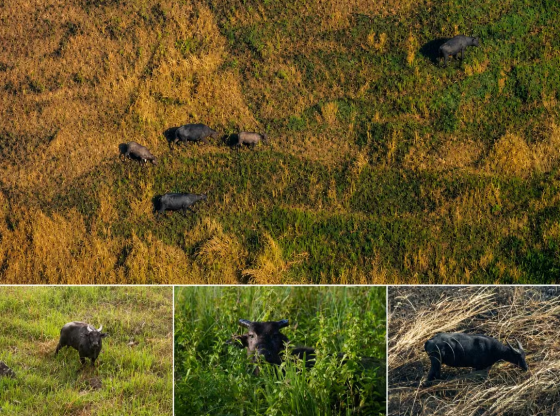


MANILA, Philippines — Delivering a major triumph for local biodiversity preservation, conservation efforts for one of the world’s rarest mammals have yielded exceptional results. The Department of Environment and Natural Resources (DENR) – MIMAROPA confirmed that the monitored population of the critically endangered tamaraw (Bubalus mindorensis) jumped by approximately 12 percent this year.
The successful census underscores the vital impact of sustained, ranger-led protection across the mountain sanctuaries of Mindoro Island.
The official metrics were finalized by the Tamaraw Conservation Program Office (TCPO) following the 2026 Annual Tamaraw Population Count conducted from April 15 to 20. Field teams monitored the core zone of the Mounts Iglit-Baco Natural Park (MIBNP), which acts as the primary long-term sanctuary for the species.
The standard multi-vantage point monitoring method registered a promising upward trajectory:
                          [ THE 2026 TAMARAW POPULATION ANALYSIS ]
                                             │
         ┌───────────────────────────────────┴───────────────────────────────────┐
         ▼                                                                       ▼
   [ METRIC POPULATION GROWTH ]                                            [ HEALTHY HERD DYNAMICS ]
 • **From 380 to 425:** The consolidated headcount reached **425   • **Complete Representation:** Field rangers recorded sightings of
   tamaraws** within the MIBNP core zone, a solid leap from the       • adults, sub-adults, yearlings, and calves across the stations.
   380 individuals documented in 2025.                                • **Active Recruitment:** The presence of new calves and yearlings
 • **100% Sightings Success:** Every single designated vantage point  • provides concrete evidence of healthy, ongoing recruitment and
   recorded active herds, including areas that saw zero sightings last• breeding success within the monitored wild population.
   year.                                                              • **Strict Validation:** Field observers systematically cross-checked
                                                                       • records to eliminate double-counting and ensure accuracy.
While Mounts Iglit-Baco Natural Park serves as the ultimate stronghold—holding roughly 80 percent of the remaining wild population—the DENR emphasized that the 425 figure strictly represents the population within this specific core zone.
To ensure long-term genetic rescue and a broader recovery path, parallel conservation networks actively monitor and manage Mindoro’s other verified tamaraw pockets:
[ THE MINDORO WILD TAMARAW HABITATS ] │ ▼[ Mts. Iglit-Baco ] ──► The primary, heavily guarded natural park featuring the country's largest known remaining wild population, acting as the benchmark monitoring baseline since 2000. │ ▼[ SADIK Critical ] ──► The proposed **Siburan–Aruyan–Dangari–Iyason–Kinarawan (SADIK) Critical Habitat**—formerly the Aruyan-Malati Tamaraw Reservation—which hosts an independent wild sub-population. │ ▼[ Upper Amnay ] ──► The isolated **Upper Amnay Watershed** corridor, which serves as a vital secondary range undergoing independent ecological mapping and localized tribal co-management initiatives.
The census relied strictly on the Intensive Concentration Count (ICC), also known as the Simultaneous Multi-Vantage Point Count Method. This standardized framework has been consistently executed by the DENR since 2000 to maintain data integrity. During the five-day survey, trained observers from the MIBNP Protected Area Management Office, local government units, academic institutions, non-governmental organizations, and Indigenous communities spent mornings and afternoons tracking vantage points to log accurate wildlife movements.
The 12 percent growth brings welcome relief for an endemic Philippine bovine that has faced a steep upward battle against extinction. Once numbering around 10,000 in the 1960s, the tamaraw population plummeted drastically due to trophy hunting, illegal land clearing, and disease outbreaks. While the species remains strictly classified as “Critically Endangered” by the International Union for Conservation of Nature (IUCN), the 2026 data shows that combining local ranger-based enforcement with structured habitat protection can successfully reverse a historical decline—ensuring that Mindoro’s iconic dwarf buffalo continues to thrive in its ancestral wilderness.